

Double-crested Cormorant

Updated: Sep 13
There is nothing quite like the sight of a crowded colony of Double-crested Cormorants on Mandarte Island’s southwest rock bluff—hundreds of adults standing guard over their thick-stick nests perched high above the remote island seashore. This and scenes of them drying their plumage with outstretched wings led to their inclusion on my list of Five Finest Feathered Friends (Great Blue Heron • Bald Eagle • Turkey Vulture • Double-crested Cormorant • Black Oystercatcher).
Of the nearly two hundred resident and part-time bird species in the Southern Gulf Islands, those that spend much of their time along the ocean shorelines, with their eyes on a meal, are the ones I enjoy seeing most.
Table of Contents
Photographs, videos, audio, and text Copyright © 2026 Richard Philpot/SGIOUTSIDE.ca.

Double-crested Cormorant nests on the high bluff of Mandarte Island’s southwest shore. This remote SGI is home to large colonies of Double-crested and Pelagic Cormorants (080312).
Double-crested Cormorant—Distinctive among the three SGI species
The matte-black-coloured Double-crested Cormorant, with its vibrant yellow-orange facial skin (at all ages), dazzling aquamarine eyes, snaky-shaped neck, and blue mouth on the inside, makes it distinctive among the three cormorant species that inhabit the Southern Gulf Islands. In addition to appearance distinctions, the Double-crested’s crook neck in flight makes it easy to tell it apart from the Brandt’s and Pelagic cormorants. And as the heaviest of the Pacific cormorants, they sit lower in the water. All are expert fish catchers.
Double-crested, Brandt’s, and Pelagic cormorants are mostly black-coloured upright-perching water birds. Each has a hooked, laterally flattened bill and rigid tail feathers. When perching on a drift log, piling, or cliff edge, they often adopt an upright pose with wings outstretched, drying their plumage (i.e., flight feathers) in the sun—some say, looking like a court lawyer in robes; hence one of its nicknames: Lawyer. Instead of shedding water like other waterfowl species’ waterproofed feathers, cormorant feathers, lacking sufficient preen oil, get soaked when they dive for food. While this may make them more agile and speedy when foraging underwater, it necessitates a post-fishing dry-off period. The Double-crested holds this spread-wing posture for longer than the others.
These colonial waterbirds seek out an aquatic “homeland” that meets their dietary needs. Hence, they are a common sight in the Southern Gulf Islands year-round. Our three cormorant species like to forage for food near one another. Does this mean they compete for prey? Research says no. Most often, Double-cresteds hunt in water covering a sandy or flat seafloor, while Brandt’s and Pelagics like rockier water environments.
Normally, Double-crested cormorants dive less than nine metres (approximately 30 feet) in pursuit of food; however, they can dive to 30 metres (approximately 100 feet). Brandt’s and Pelagics, on the other hand, dive to 70 metres (approximately 230 feet) and 55 metres (approximately 180 feet), respectively. The cormorant’s hooked upper bill is perfectly shaped for catching prey.
Double-crested and Brandt’s “run” along the ocean surface to reach takeoff speed, while the smaller Pelagics launch directly from the water into flight. Oddly, Double-crested frequently fly over land, unlike their cousins.
Two of our three cormorant species are under some threat. Double-crested are British Columbia Conservation Data Centre (CDC) Blue-listed—species is of concern of being lost—and Brandt’s are Red-listed—species is at risk of being lost. Pelagic are Yellow-listed—species is not of concern of being lost. The declining numbers of Double-crested and Brandt’s in our region are the result of nest predation from other bird species, chemical maritime pollution, commercial gill-net entanglements, and unnecessary human disturbance. Adult cormorants raising their necks while around or on their nest are disturbed. If they fly away, they leave their eggs or chicks exposed to potential predators such as eagles, gulls, and crows.
Species profile: Double-crested Cormorant (Phalacrocorax auritus)
Status: BC Conservation Data Centre (CDC): Blue (species is of concern of being lost).
Seasonal Abundance: Common in the SGI, with an increased presence in winter.
Range: Most widespread cormorant in North America, from Alaska south to Mexico; in British Columbia, breeds mainly in the Strait of Georgia and Strait of Juan de Fuca regions.
Habitat: Ocean coast plus lakes, rivers, and swamps.
Description: Size—70-90 centimetres (approx. 28“-35”); wingspan—to 1.2 metres (4’); weigh 1.4-2.5 kilograms (approx. 3-5.5 lbs); nonbreeding adults—solidly built with orange throat pouch with long neck hooked bill; breeding adults—short double crest of white feathers over each eye (only in breeding season); immature—browner with pale colouring on breast and neck; float low on the water with head and bill tilted upward slightly.
Flight: “Runs” along the ocean surface to reach takeoff speed; before takeoff, it stretches its neck in the direction of flight; wingbeat bursts are slow and choppy with head up, S-shaped neck, and hanging belly; often flies in irregular V-shaped flocks, repositioning in the V; short glides; landing, it puffs out its orange neck; touchdown includes a post-landing hop.
Calls: Generally silent; oinking-pig-reminiscent grunts when taking off and landing, when showing aggression, and during mating; listen to Double-crested Cormorant at Cornell Lab of Ornithology’s All About Birds.
Vision & Sense of Smell: Rely on adapted underwater vision rather than smell to hunt their prey.
Diet: Large assortment of fish, plus some crustaceans, amphibians, and insects; after eating, they retire to airy perches to digest their meal and dry.
Nesting: Colonies high on cliffs or in trees near water, and on rocky islands; well-made, bulky nests of sticks, seaweed, and other materials (including pieces of fishing net, boating garbage, and plastic debris, parts of dead birds, and nesting materials from unguarded cormorant nests); masses of fecal matter below nests can kill nest trees, requiring nesting on the ground; they are usually outnumbered when sharing a cliff nesting location with Brandt’s; as many as twenty nests in a single tree.
Reproduction: Lay 1-7 pale-blue, chalky-coated eggs between May and October; 1-2 broods; incubation period 25-28 days; nestling period 21-28 days; if nests are on the ground, young may leave to congregate with other youngsters, returning to their nest at feeding time; adults ferry water in their mouths to pour into the mouths of chicks.
Life Expectancy: Oldest known was nearly 24 years old.
Stressors & Threats: Vulnerable to maritime oil spills and chemical pollution (also threatening their prey), gill-net entanglements, and human disturbances, including nesting-colony harassment by boaters and humans and pets on land, which may lead to broken or stolen eggs and/or abandonment of the colony.
Brandt’s Cormorant
Brandt’s are the largest of the Pacific cormorant trio. During breeding season, they flaunt a vivid cobalt-blue throat pouch and blue eyes with delicate white feathers on their head, neck, and back. Sounds made by the adults at the nest are barely audible, even from an arm’s length away.
Species profile: Brandt’s Cormorant (Phalacrocorax penicillatus)
Status: BC Conservation Data Centre (CDC): Red (species is at risk of being lost).
Seasonal Abundance: Common during most of the year.
Range: Southwestern Alaska to Baja California.
Habitat: Marine coastlines and estuaries; likes areas with strong tidal currents; scarcely found inland other than when migrating.
Description: Size—84-89 centimetres (approx. 33“-35”); wingspan—to 1.2 metres (4’); average weight 2.1 kg (4.6 lbs); largest of the Pacific cormorants; long neck and hooked-tipped bill, medium-length tail, short legs, large and webbed feet; nonbreeding adults—all-black with yellow-orange-coloured chin, breeding adults—cobalt-blue eyes and throat pouch, delicate white feathers on its head, neck, and shoulders; immature—plain dark brown with paleish neck and breast.
Flight: Also “runs” along the ocean surface to reach takeoff speed; flies low above the water surface in long lines, holds neck nearly straight, shows shortened tail.
Calls: Usually silent; sounds made by the adults at the nest are barely audible—throaty growls, grunts, and croaks; listen to Brandt’s Cormorant sounds at Cornell Lab of Ornithology’s All About Birds.
Vision & Sense of Smell: Rely on adapted underwater vision rather than smell to hunt their prey.
Diet: Forages underwater in nearshore, nutrient-rich upwelling ocean areas that attract fish, grasping its catch near the water surface; also dives for food to rocky structures and the sea bottom, capable of swimming down 70 metres (approximately 230 feet) in pursuit of food; usually forages in large flocks (often with other seabirds); leaps clear of the water surface to start the diving process.
Nesting: Breeds in dense colonies on rocky islets and cliffs; bowl-like nests of sticks (and driftwood), marine algae, grasses, weeds, and moss; nest averages 35 cm across (approx. 14”), 15 cm tall (approx. 6”), interior bowl 20 cm across (approx. 8”) by 9 cm deep (approx. 3.5”); males build a nest site before they have a mate.
Reproduction: 3-6 bluish-white eggs; incubation by both sexes; male attracts female mate by parading its vivid-blue throat pouch or by waving its wings and pumping its head; female may battle another female that has stolen its nest site; mating pairs usually only partner for one season.
Life Expectancy: Oldest recorded was nearly 18 years.
Stressors & Threats: Same as Double-crested.
Pelagic Cormorant
The Pelagic is the smallest and leanest of the three SGI species. The breeding adults’ deep-red lores and white patch on their rear flanks stand out from their glossy blackish-green overall colour. They fly with their thin neck “broomstick” straight. Unlike their gregarious cousins, Pelagics are usually seen solo or in pairs. “Pelagic” is defined as “relating to the open ocean”—an inaccurate description for a species that rarely ventures more than a few kilometres from land.
Species profile: Pelagic Cormorant (Phalacrocorax pelagicus)
Status: BC Conservation Data Centre (CDC): Yellow (species is not of concern of being lost).
Seasonal Abundance: Widespread; year-round resident.
Range: West and east Pacific coasts from the Bering Sea south to Japan and California.
Habitat: Saltwater-only; rocky shorelines, bluffs, docks; don’t venture far out to sea.
Description: Size—51-76 centimetres (approx. 20“-30”); wingspan—to 1.2 metres (4’); weigh 1.4-2.4 kilograms (approx. 3-4.4 lbs); smallest and slimmest of three local cormorants; nonbreeding adults—blackish with greenish/purplish luster, slim neck and head, narrow wings, dull facial skin, with fine black bill, longish tail (noticeable when perched); breeding—small patch of coral-red skin around bill, square white rear-flank patches, fore and aft crests visible at close range; immature—evenly dark brown.
Flight: Launch directly from the water into flight; faster wingbeat than Double-crested and Brandt’s; flies with their thin neck “broomstick” straight.
Calls: Primarily silent, but when breeding (when males make grunting and groaning calls and females make croaking and clicking calls); listen to Pelagic Cormorant at Cornell Lab of Ornithology’s All About Birds.
Vision & Sense of Smell: Rely on adapted underwater vision rather than smell to hunt their prey.
Diet: Mainly schooling fish like Pacific herring and sand lance, but also small crustaceans and other invertebrates; forage in rocky water; can dive deep, holding their breath for two minutes (have been found in fishermen’s nets at 55 metres (180 feet).
Nesting: Nest on steep and narrower out-of-sight ledges on coastal cliffs and rocky islands; nest bowl made mostly of seaweed and grass, bound together and to a rock ledge with guano (excrement); nests can be used for many years and grow to quite large.
Reproduction: 1-8 chalky-blue or greenish-white eggs; both parents feed chicks until fledging, travelling as many as 40 kilometres (approximately 25 miles) per day to find food; males defend nest site, growling, poking their head, and flapping their wings at rival males; males will fight to protect their nest ledge, grabbing their adversary’s bill to remove him.
Life Expectancy: Oldest recorded in BC was almost 18 years old.
Stressors & Threats: Same as Double-crested and Brandt’s; Thousands of Pelagics died in the 1989 Exxon Valdez oil spill in Alaska.
My Other Favourite Finest Feathered Friends (left to right): Great Blue Heron • Turkey Vulture • Bald Eagle • Black Oystercatcher

Great Blue Heron with a fresh catch in the Thieves Bay shallows (North Pender Island). 
A Turkey Vulture riding warm thermal updrafts above the Swanson Channel shoreline. 
A Bald Eagle scanning the surrounding skyline from its perch on a Douglas fir branch. 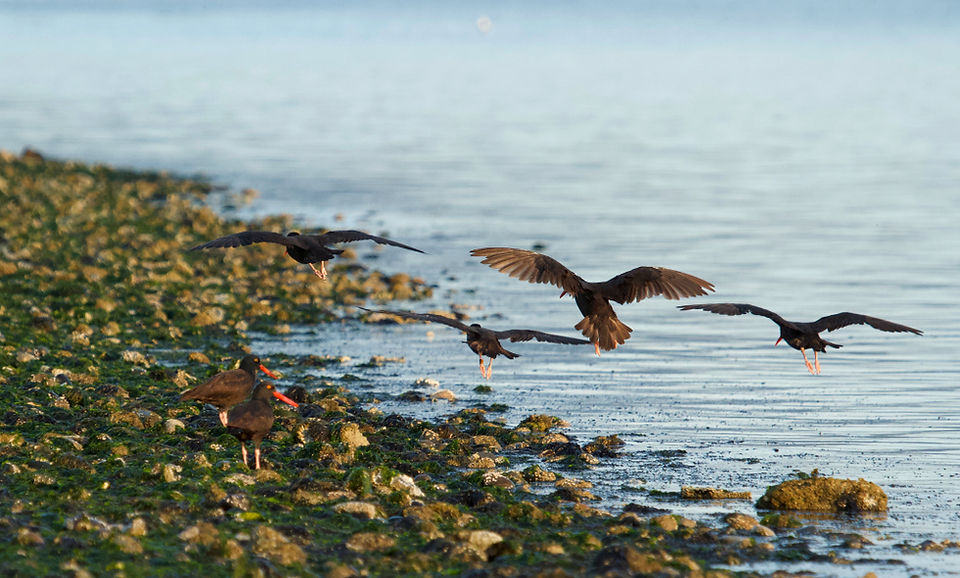
Black Oystercatchers landing on Sidney Spit, Sidney Island.
Birding in the SGI
The climate and location of the Southern Gulf Islands make the area an important year-round residence, a winter destination, and a migratory flyway. Mid-April to mid-May is the ideal time for birding, when winter and summer birds overlap, though there are plenty to see year-round. A field guide, a smartphone bird app like Merlin, and binoculars are necessities. A spotting scope is even better for viewing raptors, like Bald Eagles and water and shorebirds. Of the hundreds of bird species to be sighted in the SGI, not all are common to all islands.
In addition to Five Finest Feathered Friends, birders can look forward to sightings of Belted Kingfishers, Common Ravens, Rufous Hummingbirds, Pileated Woodpeckers, California Quail, Trumpeter Swans, Pacific Loons, and a great many other shorebirds and songbirds. See the eBird: Bird Lists by SGI locations for extensive inventories of species seen in various places.
Birding ethics: So that no harm comes to the birds or the environment
Three things to keep in mind when observing our feathered friends.
Keep your distance. As exciting as it is to get “this close” to a particular bird or a nest, remember that if you’re so close that the bird leaves, you’re too close. The bird will fly to safety, and may do so at the risk of leaving eggs or chicks unprotected from predators. I have unwittingly caused too many birds to take flight in the past and now adhere to a 100-metre rule. With binoculars, I can see the bird clearly from 100 metres as it goes about its normal routine. Keeping your distance also applies to your dog; please don’t let your four-legged friend take chase.
Leave no trace. Do your best not to damage the bird’s natural environment. Remove everything that you bring with you. Leaving garbage, in particular picnic food scraps, may attract predators. Please DO NOT feed wild birds.
Let nature be. A bird may appear abandoned or in distress, but probably isn’t. Young birds on the ground likely are learning to fly. Don’t worry; a parent is undoubtedly close by and will return as soon as you leave. Even a bird that appears injured or dead may not be. If it’s a hummingbird, it may be in a state of torpor—a dormant, inactive state of hibernation (in other words, this high-energy bird is simply resting). If you are certain a bird is injured, contact a local veterinarian or recognized wildlife rescue organization before touching or moving it.

Two Double-crested Cormorants drying their wings on one of the Belle Chain Islets (121405).
Good locations in the SGI to see a Cormorant
Nests on the high bluff of Mandarte Island’s southwest shore (Inner Islands); paddling in many places in the SGIs, like Around South Pender Island, in Bedwell Harbour (Pender Islands), along the North Pender Island shoreline in Swanson Channel between Wallace Point and Oaks Bluff.
*eBird: Bird Lists by SGI locations highlighted in SGI Outside
The side menu in the linked eBird Bird Lists lets you view the Iconic Birds of that location and the best time to see them. eBird: Bird Lists are constantly evolving (SGI Outside regularly updates the number shown below).
See the eBird Hotspot Map for the Southern Gulf Islands.
North Pender Island
George Hill Park (GINPR): 99 species seen since 2017 (eBird)
Medicine Beach Nature Sanctuary—138 species since 2013 (eBird)
Mount Menzies (GINPR): 34 species seen since 2022 (eBird)
Roe Islet Trail, Roesland (GINPR): 101 species seen since 2015 (eBird)
South Pender Island
Beaumont Marine Park (GINPR): 80 species since 1989 (eBird)
Brooks Point Regional Park (CRD): 155 species since 1998 (eBird)
Greenburn Lake (GINPR): 110 species since 2004 (eBird)
Mount Norman Summit (GINPR): 89 species since 2007 (eBird)
Salt Spring Island
Mount Maxwell Park (BC Parks): 88 species since 1996 (eBird)
Mount Erskine Park (BC Parks): 75 species since 2015 (eBird)
Reginald Hill (SSIPARC/CRD): 57 species since 2023 (eBird)
Ruckle Park (BC Parks): 155 species since 1979 (eBird)
W̱EN,NÁ,NEĆ Tsawout First Nations Trail: 63 species since 2024 (eBird)
Mayne Island
Campbell Point (GINPR)/Bennett Bay: 140 species since 2018 (eBird)
Georgina Point Heritage Park & Lighthouse (GINPR): 98 species since 2003 (eBird)
Mount Parke (CRD): 81 species seen since 1996 (eBird)
St. John Point Regional Park (CRD): 64 species seen since 2023 (eBird)
Saturna Island
Xwiwxwyus (kwik-wi-us)/Winter Cove (GINPR): 143 species since 1973 (eBird)
Brown Ridge (GINPR/Campbell Farm): 88 species since 1973 (eBird)
East Point Whale Trail/East Point Regional Park (GINPR/CRD): 164 species since 1989 (eBird)
Narvaez Bay (GINPR): 107 species since 2013 (eBird)
Galiano Island
Bellhouse Park (BC Parks): 105 species since 2007 (eBird)
Gray Point Trail/Montague Harbour Marine Park (BC Parks): 129 species since 1970 (eBird)
Mount Galiano Nature Preserve: 68 species since 2005 (eBird)
Matthews Point Regional Park (CRD): 79 species since 2010 (eBird)
The Viewpoint Trail/The Bluffs (Galiano Club & GIPRC): 102 species seen since 1990 (eBird)
Inner Gulf Islands
Portland Island (GINPR): 134 species since 2002 (eBird)
Russell Island (GINPR): 80 species since 2009 (eBird)
Isle-de-Lis/Rum Island Trail (GINPR): 67 species since 2015 (eBird)
Mandarte Island bird research station (IBA Canada site): 107 species since 1960 (eBird)
CRD - Capital Regional District, GINPR - Gulf Islands National Park Reserve, PIPRC - Pender Islands Parks & Recreation Commission, SSIPARC - Salt Spring Island Parks, Arts, Recreation & Culture, MIPRC - Mayne Island Parks & Recreation Commission, SIPRC - Saturna Island Parks & Recreation Commission, GIPRC - Galiano Island Parks & Recreation Commission.
Counting Birds in the SGI for the National Audubon Society Bird Count
Excerpt from A 2025 Christmas Bird Count Full of Surprises
“The official Audubon count area that contains the Mayne Island count includes Saturna, North Pender, and South Pender islands. The official list submitted for our count area is a compilation of counts from each of these islands. For this year’s count the four islands tallied 91 species and 9,838 individual birds. Collectively we had 118 birders out on count day who logged just over 187 hours (this includes feeder counters) and 229 kilometres on foot, by car, or by boat to observe birds.”
Cormorant Resources (and great pictures, videos, audio)
British Columbia Breeding Bird Atlas: Double-crested Cormorant
Cornell Lab of Ornithology’s All About Birds: Double-crested Cormorant
British Columbia Breeding Bird Atlas: Brandt’s Cormorant
Cornell Lab of Ornithology’s All About Birds: Brandt’s Cormorant
British Columbia Breeding Bird Atlas: Pelagic Cormorant
Cornell Lab of Ornithology’s All About Birds: Pelagic Cormorant
Birds of Southwestern British Columbia (7th printing) by Richard Cannings • Paperback • $19.95 • 432 pages • Harbour Publishing, 2008. Covers more than 200 bird species in a handy, portable guide; aimed at beginning and intermediate birders.
Merlin • Merlin is a smartphone bird app created by the Cornell Lab of Ornithology; it provides birders with the ability to Identify Bird Songs and Calls, Identify Birds in a Photo, Save Birds to Your Life List, and Explore Lists of Birds Near You using your cell phone. Watch the See How Merlin Can Help You ID Birds demo video below for an introduction to this amazing bird-ID assist tool.


