

You’ll be green with envy if you skip the Greenburn Lake hike

Updated: 6 days ago
Abundant wildflowers and a panoramic vista set Greenburn Lake hike apart from the trek around Roe Lake, the other freshwater lake on the Penders. The wildflower array at Greenburn is lovely from April through July, particularly along the north side of the lake, at the high-elevation bluff viewpoint, and near the bridge in late June and early July.
Table of Contents
Photographs, videos, audio, and text Copyright © 2026 Richard Philpot/SGIOUTSIDE.ca.

Yellow Flag (invasive) and Yellow Pond Lily dominate Greenburn Lake’s east end from mid-May through June (071323).
GREENBURN LAKE TRAIL (South Pender Island)
Gowlland Point Road Trailhead
Gulf Islands National Park Reserve (GINPR/Parks Canada)
RP’s most recent visit: September 17, 2026
Overview
Long-legged waders, tree-clingers and perchers, ducks, and soaring birds frequent this mountain lake and the nearby bluff. Great Blue herons and Bald eagles are often heard before you see them. The 180-degree view from the bluff affords a stunning view of the US San Juan Islands, more of the Southern Gulf Islands, and Vancouver Island. The rocky trail section on Greenburn’s north side is challenging, so skip it unless you are fit, are wearing good shoes, and are carrying your hiking essentials. Inexperienced hikers not used to trekking on wet rocks may want to wait for a nice, dry day in spring, summer, or early fall. The south side of Greenburn Lake is an easy walk.
Greenburn Lake Trail FACTS
Distances and elevations vary depending on the GPS tracker device and the digital mapping software used.
Best time of year: Anytime, but preferably in dry weather.
Difficulty Rating: MODERATE (technical in places)
Trail Type: Out & Back and Loop around Greenburn Lake (with an extension to the bluff)
Distance: 4.4 km (approx. 2.7 mi)
Time Allowance: 1.5 hours
Highest Elevation: 124 metres (407 feet)
Lowest Elevation: 65 metres (213 feet)
Elevation Gain: 59 metres (194 feet)
Dogs Permitted: Yes, on a leash at all times*
Freshwater Availability: None*
Amenities: None
Travelling to the Trailhead (Google): By vehicle—12.9 km (19 minutes) from Driftwood Centre: South to Canal Road (turn left); Canal Road becomes Spalding Road at 8.4 km and turns into Gowlland Point Road at Poets Cove Resort & Spa
Parking: In front of the Church of the Good Shepherd Anglican Church (.23 km away, near the Poets Cove Resort & Spa entrance sign); PLEASE DO NOT park in the Pender Island Fire Rescue Hall No. 3 parking lot (penderfire.org) next to the trailhead
Bike or Foot Travellers: Lock your bike to the church fence or trailhead gate; Car Stops on each side of Gowlland Point Road in front of the church
Trailhead Coordinates/Google Maps (Gowlland Point Road): 48.745000, -123.220583
Birders: 110 species since 2004 (eBird)
*See the GINPR public health advisory sign BELOW describing the potential harm to humans and animals from consuming Blue-green-algae-infected Greenburn Lake water (020926).

Route Description
The best place to park your car or truck is in front of the Church of the Good Shepherd, next door to Poets Cove Resort & Spa (at the junction of Spalding Road and Gowlland Point Road). You can parallel park about half a dozen vehicles between the paved road and the fence surrounding the Anglican Church property. Take a few minutes to read the W̱SÁNEĆ First Nations interpretive sign in front of the church, which explains The Thirteen Moons of the W̱SÁNEĆ Year and provides a condensed history of the W̱SÁNEĆ people.
The walk from the church to the start of the trail is five minutes (10 minutes from Poets Cove Resort & Spa). Follow Gowlland Point Road east toward the Pender Island Fire Rescue Hall No. 3, the grey building with red trim at the curve in the road. The Greenburn Lake Trail begins at the Parks Canada sign and bright yellow metal gate with attached no-parking sign. The trailhead gate looks more like a vehicle-traffic barrier than access for two-legged travellers.
The stretch of trail from here to the lake is a 3-4 metre (approx. 10-13 feet) wide, hard-packed gravel road that climbs through second-growth Douglas fir, Western redcedar, and Big Leaf maple forest. Until recently, Parks Canada twice gave notice that they’re watching you: signs mounted to trees advised hikers that hidden wildlife cameras in the area are snapping daily pictures (0700 and 1900). Parks Canada claimed these WEREN’T motion-activated cameras and that they deleted photos of people taken inadvertently. Should naturalist hikers, skinny dippers, and open-air lovemakers be alert to the possibility that a camera was overlooked and their illegal activities are still being recorded?
The “road” levels out for the final .5 km to the Greenburn Lake Dam. The manufactured dam, which also serves as a bridge, defines the west end of the lake. FYI: Greenburn Lake supplies water to Poets Cove. If you circle the freshwater reservoir clockwise, go straight until the wide trail narrows into a single-track path along the lake’s northern boundary. Only reeds and bullrushes separate you from the water. The view is gorgeous.
A Parks Canada sign—Caution! Risk of injury from falling rocks—marks the trail’s transformation into rocky, technical terrain. A walking stick or pole is a MUST. Be sure to securely plant your pole tip before shifting your weight. Well-fitted, grippy-soled footwear is equally essential gear. Pay close attention when placing your feet; it’s easy to get distracted by the lake, wildflowers, or massive rock formations. It’s reasonable to use the trail’s rocks to maintain your balance, but before you pull on one or use it to support your body weight, make sure it’s secure with a wiggle test. The north side of the lake is slow going because it requires attentive climbing.

ABOVE: The start of the Greenburn Lake Trail’s rocky north shore section and Parks Canada’s caution sign. BELOW: Red Paintbrush, found on the north side, is one of the many wildflowers found along Greenburn Lake and the trail to the bluff lookout.

Getting to the east end of Greenburn Lake is always emotional. A good friend lived on a property adjoining the park. We miss him dearly and always say hello when reaching this point in the hike. Don’t take either trail heading further east, as they lead to private property.
The water’s-edge trail is mostly packed earth again. It forks at the two-kilometre mark, where beavers have downed, and wind has felled, nearshore trees; round behind the uprooted Douglas fir to the trail westbound along the shoreline. The walking is easy, with occasional protruding tree roots and no climbing. Winter brings wild mushrooms. The “shrooms” are intriguing, but it’s best not to touch or eat them unless you’re knowledgeable. Some are poisonous to the touch; others, if consumed, can make you quite ill or kill you.
Views of the lake are increasingly blocked by trees as you pass through the ground cover of Salal, Sword fern, and Oregon-grape, shrinking the path. A once well-hidden, moss-covered, horizontal tree stump protruded from the matching-coloured foliage into the trail. I walked into it several times. Parks Canada trail maintenance staff have since removed the hazard.
Relax and enjoy the forest’s serenity. The tree canopy provides welcome shade during hot summer days.
The trail narrows, skirting the edge of a tiny marsh on the off-lake side. The grassy pond is clearly marked by the finest display of beaver art in the Southern Gulf Islands: a Big Leaf maple with a chunk chiselled from its trunk courtesy of you-know-who. How long did it take the “local” to whittle the tree’s main stem to that size? Parks Canada staff have assured me they don’t and won’t trap beavers residing here or at Roe Lake.

Big Leaf maple with a chunk chiselled from its trunk courtesy of you-know-who.
Greenburn Lake Sidetrack
At the next fork in the trail, veer away from the lake for a 5-10 minute Out & Back sidetrack. Soon, you will see evidence to the south that the ocean is nearby. Ignore the side trail that runs close to the edge of the rocky bluff; stick to the alternative, which leads to a safer vantage point for a high-peak scenic view. Grass species appear for the first time on the hike in this park-like clearing atop a conglomerate rock bluff, 124 metres (407 feet) above the South Pender shoreline. The 180-degree panoramic view is SPECTACULAR! If you’re afraid of heights, remain safely away from the bluff’s edge. A long-downed tree is a good resting and picnic spot. High-flying Turkey vultures and Bald eagles often drift at eye level in the updraft (your eye level).
Scanning from left to right, you look across Boundary Pass to the US San Juan Islands (Stuart Island and Turn Point Lighthouse are closest), Haro Strait, SGI’s Inner Islands, Moresby Island, Salt Spring Island, and Vancouver Island in the distance. The nearest landmass is the south end of North Pender Island. Most of the Canadian islands in the foreground are privately owned, except for Isle-de-Lis, Darcy Island, Sidney Island, Portland Island, and a few smaller islets, which are part of the Gulf Islands National Park Reserve.
If you picnic at the scenic viewpoint, you will see massive cargo ships stacked high with containers of consumer goods, bulk fluids, or grain. On arrival, these vessels turn east into Boundary Pass, reversing on departure, back out to the Pacific Ocean and various Asian countries. The invisible US-Canadian border bisects Boundary Pass and Haro Strait.
A trail continues northwest from the viewpoint, but doesn’t lead to anything worth seeing. Retrace your steps to the main Greenburn Lake Trail, then take a left turn for a short trek to a Parks Canada sign and the start of the 40-metre-long (approx. 130 feet) concrete Greenburn Lake Dam. The view east from the middle of the dam is beautiful. And tranquil.
Note. If you don’t have the energy, skills, or time to loop around the lake, proceed counter-clockwise across the dam and turn right at the first branch trail, leading to the high-peak viewpoint and picnic spot. This turns your adventure into an Out & Back hike, shortening the overall length to 1.6 km (1 mile) each way (25-30 mins). This abbreviated Greenburn Lake hike is still classified as MODERATE because of the climb from Gowlland Point Road to the dam.
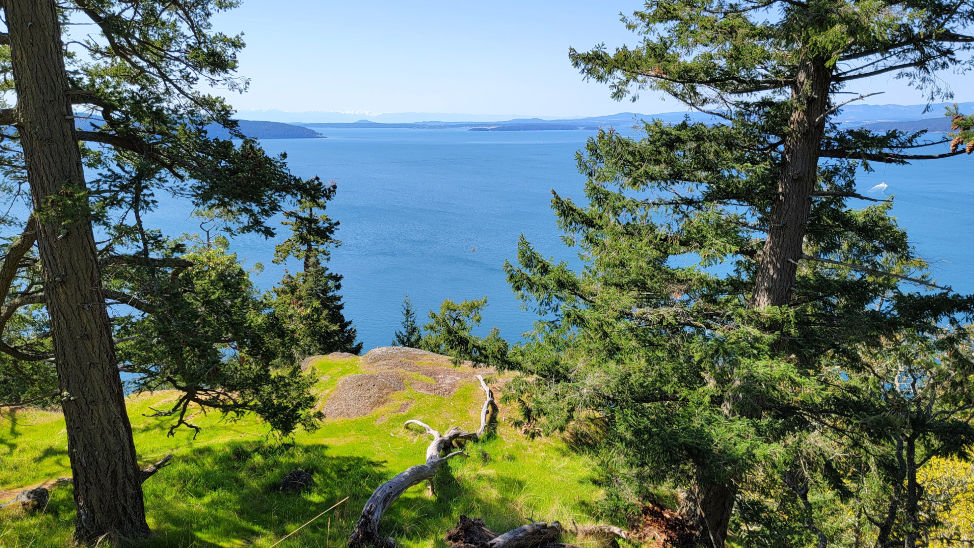
Panoramic south-facing view from the Greenburn Lake Trail sidetrack.

