

A Hawaiian island in the SGI?

Updated: Sep 8
During the maritime fur trade of the mid-1800s, Canada’s Hudson’s Bay Company (HBC) ships returning from Asia hired burly, hard-working Hawaiians as labourers. At the time, the Hudson’s Bay Company owned Portland Island, ceding it to several transplanted Pacific islanders in the latter half of the 19th century. These Hawaiian settlers, known as the Kanakas, lived on Portland Island for nearly fifty years. This is only part of the island’s diverse and colourful history.
Table of Contents
Photographs, videos, audio, and text Copyright © 2026 Richard Philpot/SGIOUTSIDE.ca.

Water levels and wind have moved an aged, rotting wooden cupboard (in the foreground) east and west among the drift logs on one of Portland Island’s south-facing, solid-rock beaches. Could it have been made by one of the island’s Hawaiian residents?
PORTLAND ISLAND (SXEĆOŦEN) SHORELINE TRAIL
Princess Bay Trailhead
RP’s most recent visit: August 10, 2026
Overview
The Southern Gulf Island’s Portland Island (SXEĆOŦEN) has been occupied or owned by Salish Sea First Nations peoples, the Hudson’s Bay Company, Hawaiians, a notorious one-armed entrepreneur and army general named Frank E. Sutton, Salt Spring Island businessman Gavin Mouat, the English Royal family’s Princess Margaret (1958-1967), the British Columbia government, and Parks Canada.
Why has the island been so popular? Is it because it’s easily accessed by watercraft? Yes, but that’s only part of it. Portland’s popularity is largely due to its spectacularly diverse nature—eight kilometres of ocean shoreline, beaches piled high with shells and sun-bleached driftwood and bordered by honeycomb-patterned sandstone rock, great picnic spots, oceanfront accommodation, quaint secluded anchorages, wildly fresh edible plants and seafood, abundant bird and marine life, pleasing views in all directions . . . and privacy.
What more could you ask for? It’s a gift that keeps on giving.
BULLETIN (PROHIBITED ACTIVITY ORDER): The stretch of trail between Princess Bay, Shell Beach, and Kanaka Bluff trailhead is closed from September 8-30, 2026 “to complete mitigation work.”
Portland Island (SXEĆOŦEN) Shoreline Trail FACTS
Distances/elevations often vary based on the GPS tracker device and digital mapping software used.
Island Size: 226.7 ha (560 acres)
WATER ACCESS ONLY: By paddle craft, private boat, or water taxi
Best time of year: Anytime; wildflower season and low tides are the most interesting
Difficulty Rating: MODERATE
Trail Type: Loops (but with cross-island options)
Distance: 7-8.5 km (approx. 4.3-5.3 miles)
Time Allowance: 3-5 hours
Highest Elevation: 17 metres (56 feet)
Lowest Elevation: Sea level
Dogs Permitted: Yes, leashed at all times
Amenities: Information/history/interpretive signs at Princess Bay, Royal Cove, and Arbutus Point; picnic tables and pit toilets in three camping areas: Princess Bay, Shell Beach, and Arbutus Point; GINPR boat anchoring in Princess Bay and Royal Cove
Backcountry Camping Reservations (three locations): Princess Bay—12 primitive campsites, Shell Beach—6 primitive campsites, Arbutus Point—6 primitive campsites; each location has a food cache, a pit toilet, no potable water, portable camp stoves only (wildfire bans frequently in effect)
Fresh Water Availability: None
Anchoring: Princess Bay and Royal Cove
Trailhead/GPS Coordinates: Princess Bay Campground/Dock—48.72090, -123.36972, Shell Beach Campground—48.72199, -123.38430, Royal Cove Dock—48.73388, -123.37087, Arbutus Point Beach—48.73462, -123.36707
Travelling to the trailhead by human-powered watercraft: From Drummond Park (Fulford Harbour, Salt Spring Island) to Shell Beach—4.3 nmi (approx. 8 km), to Princess Bay (west-side route)—5.3 nmi (approx. 9.8 km); From Thieves Bay Marina (North Pender Island) to Arbutus Point Beach—3.3 nmi (approx. 6 km), to Princess Bay—3.3 nmi (approx. 7.5 km), to Shell Beach (north-side route)—4.5 nmi (approx. 8.3 km), to Shell Beach (side-side route)—4.9 nmi (approx. 9 km)
Birders: 134 species since 2002 (eBird)


GINPR Portland Island (SXEĆOŦEN) map sign highlighting the island’s hiking trails and the Princess Bay camping area and historic fruit orchard (051225), with interpretive signs giving some history of General “one-arm” Sutton’s grand plans, the lives of Portland’s Hawaiian settlers, and information about the island’s invasive species.
Portland Island HISTORY
Portland Island’s English name comes from the British Royal Navy’s flagship, HMS Portland.
Coast Salish First Nations peoples inhabited Portland Island for thousands of years. Their name for the island is SXEĆOŦEN, translated into English as “dry mouth.” The term is believed to refer to the south-facing Princess Bay foreshore, where, during low tides, the seafloor is exposed or “dries.” Shell middens, a mix of human-generated debris including shellfish remains, animal bones, and other artifacts—such as those at Shell Beach and Arbutus Point—are a visible indication of Coast Salish First Nations peoples’ habitation over many centuries. (British Columbia’s middens are protected under provincial law and are not to be disturbed.)
While stopped in Hawaii during the maritime fur trading years, the Hudson’s Bay Company (HBC) hired hundreds of locals to crew on their ships. The appeal of Hawaiians lay in their size, strength, swimming and fishing abilities, and proficiency in working on oceangoing vessels. Back on Canada’s west coast, they also acted as interpreters for English-speaking fur traders in their interactions with coastal Indigenous peoples.
The largest Kanaka (people of Hawaiian ancestry) settlements were in the Southern Gulf Islands (Salt Spring, Russell, and Portland Islands, in particular). So many Hawaiians populated the area that the SGIs were nicknamed “Little Hawaii.” These South Pacific immigrants became landowners and worked as farmers, fishermen, and timber workers.
Many of the transplanted Hawaiians came directly to Canada, but some found their way to the northwest United States. These Kanakas moved north to British Columbia after being denied the right to own land in the U.S. HBC claimed ownership of Portland Island during the fur trade and, in the second half of the 19th century, gave the island to immigrant Hawaiians William Naukana and John Palua. The buildings they constructed are long gone, and properties the size of 18-hole golf courses they cleared are long overgrown, but some of the fruit trees they planted almost two hundred years ago are still producing. The Hawaiian Canadians remained on Portland Island until 1907.
In English, Kanaka refers to people of Hawaiian ancestry, and in the context of the Southern Gulf Islands’ history, the Hawaiians who settled here for all or part of their lives.
General Frank E. “One-Arm” Sutton lost his arm in a bizarre hand grenade incident during the 1915 Gallipoli Campaign of the First World War. When a hand grenade landed in a shell hole occupied by Sutton and five other soldiers, he tossed it right back at the enemy. He caught a second grenade mid-air and threw it back again. Sutton’s luck ran out with a third grenade; it exploded, shredding his arm.
A general’s salary, royalties from his patented weaponry, and a $150,000 lottery windfall in the mid-1920s made Sutton a wealthy man. His net worth was reportedly $14 million when he retired in Victoria. In 1927, with money he had won betting on horse races in China, Sutton bought Portland Island. The following year, he cleared and planted an orchard and built a stable and race track for his 40 thoroughbred horses—to complement his plans for a summer resort and golf course (Sutton was an accomplished one-armed golfer). His grand plans and ownership of Portland Island ended with the Great Crash of 1929. The Wall Street stock market crash wiped out his fortune.
Salt Spring Island businessman Gavin Mouat owned Portland Island for a period around World War II.
In 1958, Portland Island was gifted to the English Royal family’s Princess Margaret to commemorate her visit to British Columbia. She gave it back to the people of British Columbia in 1967 to mark the 100th anniversary of Canadian Confederation, apparently a reluctant gesture. The island was to become part of the BC provincial park system. Princess Margaret Marine Park remained as such until becoming a significant addition to Parks Canada’s Gulf Islands National Park Reserve in 2003. According to the first panel of the Princess Bay educational sign: “The Princess Margaret portion of the national park reserve includes the 226.7-hectare island, some islets [including the Pellow Islets] and an adjacent 315-hectare marine area.”

Kayaks balanced on drift logs on Shell Beach. The rudder of the yellow-deck double is pointing at Brackman Island (070923). Low tide mudflats at Shell Beach; Salt Spring’s Mount Maxwell in the distant centre (072221).

Shoreline Trail Description
Trekking the Portland Island Shoreline Trail can start from one of four locations: Princess Bay, Shell Beach, Royal Cove, or Arbutus Point. The route details are the same. Skip down to the relevant starting-point heading, then back up to the earlier headings when appropriate. Regardless of your starting point, a fabulous hike awaits.
Everyone arrives at SXEĆOŦEN by boat. Visitors arriving by private sailboat, powerboat, or water taxi typically come ashore at the Princess Bay dock. Just up from the dock, a Parks Canada information sign provides island explorers with island history, a map, tide tables, invasive species warnings, and rules regarding boating behaviour around orcas (killer whales). The trail from the info sign proceeds southwest or northeast. A clockwise route choice forks in the first hundred yards (stay to the right), leading you briefly inland before returning to the shoreline, but high above the water’s edge. A short jaunt back inland with more forks in the road (again, choose the right option) and the trail delivers you to the Shell Beach camping area with its pit toilet, picnic tables, and most importantly, a sand beach.
Shell Beach
This is my favourite spot on Portland Island. Who doesn’t love powdery sand between their toes, weathered sun-bleached driftwood seats, wonderful sunset views of neighbouring islands, pickable fresh berries for breakfast or lunch, and the magical sound of waves crashing onto shore (generated by passing ferries). Be sure to stroll to both ends of the beach. At zero or sub-zero tides, the mucky mud flats at the south end are particularly interesting. This is where I first saw the intriguing plunger-shaped egg casings left by Lewis’ Moonsnails.
Across the narrow waterway directly to the west of Shell Beach is Brackman Island (GINPR). The island was designated an ecological reserve in 1989, after the B.C. government, the Nature Conservancy of Canada, and the Nature Trust of British Columbia acquired it from its private owner. Brackman Island is noteworthy because it’s never been logged, grazed by livestock, or lived on, other than by the W̱SÁNEĆ people (the W̱SÁNEĆ call the island XEXEĆOŦEN). Parks Canada acquired ownership of the island and later designated it a Special Preservation Area to protect old-growth forest and numerous rare plant species. No public access is permitted.
A dark-green sign near the split-rail fence defining the edge of the camping area directs you north along the beach to reconnect with the proper shoreline trail. At the rock-and-driftwood divide that splits off the northern section of the beach, another green post with No Fire and No Camping symbols attached marks re-entry inland. I ignore this sign in favour of a walk on the north beach and, at the far end, an obvious path up to the main trail. A GINPR trail map sign indicates you've found your way; turn left.
From here to Kanaka Bluff, the trail narrows and weaves through Arbutus angled over the ocean’s edge, one hundred feet below. A short branch trail leads to the backside of a GINPR “billboard,” a white, solar-powered maritime navigation marker, and a nice view of the south end of Salt Spring Island and its tallest mountain peaks. Kanaka means “human being, person, individual” in the Hawaiian language. Kanaka maoli means “full-blooded Hawaiian person.” In English, Kanaka refers to people of Hawaiian ancestry and, in the context of the Southern Gulf Islands’ history, to Hawaiians who settled here for all or part of their lives.
The North Shore
From Kanaka Bluff, the Portland Island Shoreline Trail heads northeast, disappearing into the darkness of a dense, mostly Douglas-fir forest, where, at times, trail conditions demand extra focus. The forest ground cover alternates between Salal, Oregon-grape, Orange honeysuckle, and ferns, often hiding tree roots or trail erosion. But the danger is avoidable if you’re paying attention.
The trail escapes the damp-feeling forest several times, crossing dry, grass-covered rock headlands jutting into the ocean channel between Portland and Salt Spring. Not only is the view from each of these headlands beautiful, but so is the diversity of wildflowers blanketing these spots from April through July: Common camas, Nodding onion, stonecrop, and more. The flower array isn’t the best on the island; it’s different and fantastic, as is the selection at the west (Shell Beach) and east (Arbutus Point) ends.
At two of these clearings, trail information/map signs indicate options for navigating the cross-island trails or continuing along the shoreline. Inland of the second sign is a clearing that was part of Hawaiian settler William Naukana’s 160-acre property. The Naukana’s buildings are long gone, but at least one of the apple trees he planted is still bearing delicious fruit. Back on the shoreline trail, not far past the second sign, and after encountering new-growth Garry oak and Arbutus, you arrive at Royal Cove. The small island across from Royal Cove is privately owned Chads Island. Royal Cove features another GINPR three-panel education station; this one covers the island’s flowering plants, the Princess Margaret connection, and forest renewal. Sheltered Royal Cove is a popular anchorage for boaters. The Parks Canada dock makes it easy for small watercraft to come ashore if the operator can’t or prefers not to land on a beach.
The Naukana’s buildings are long gone, but at least one of the apple trees he planted is still bearing delicious fruit.

Broad-leaved Stonecrop 
Cooley’s hedge-nettle 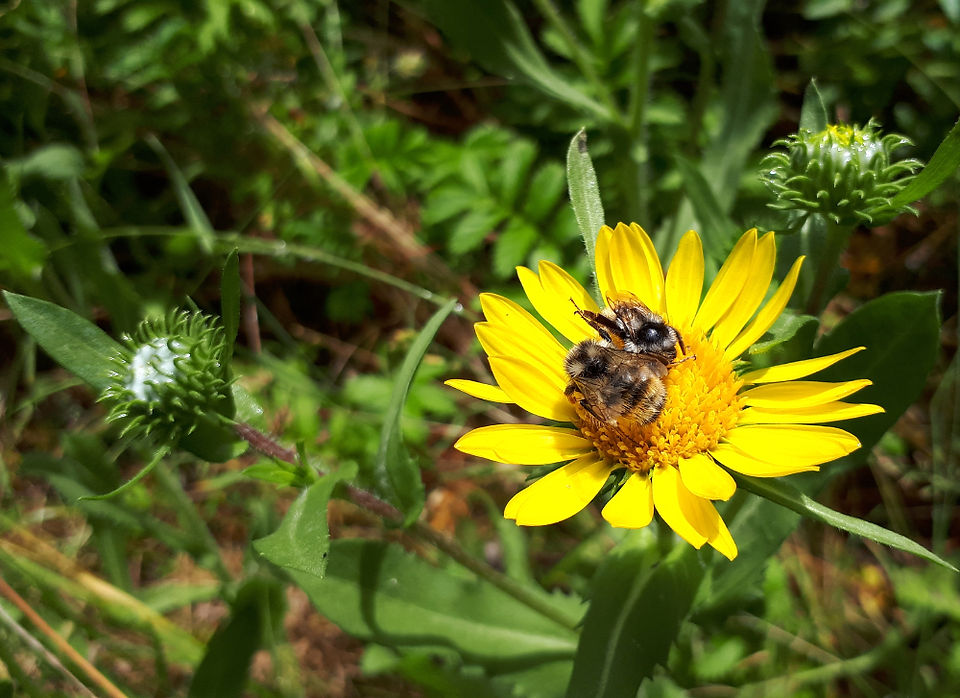
gumweed
Broad-leaved Stonecrop (051225), Cooley’s hedge-nettle (071425), and gumweed (070420).
Arbutus Point
A little more than half a kilometre separates Royal Cove from Arbutus Point. In between, you traverse wide, wooden stairs and pass yet another GINPR trail map and services sign; pay attention to this one because you are going to choose the Princess Bay option from here after visiting Arbutus Point. For now, proceed straight and downhill. Take either of the next trail options to reach the easternmost point of Portland Island. The branch trail left feeds down to Arbutus Point Beach, a popular landing spot for day-use and overnight paddlers.
The best things about Arbutus Point are: an accessible beach at all tides, sunrise, a diversity of wildflowers, and the finest intertidal exploring in the Southern Gulf Islands. If you plan your visit during summer’s lowest tides, you’ll be rewarded with fascinating ocean life sightings. And I can’t ever recall spending time here without seeing at least one Bald Eagle and Great Blue Heron. The panoramic view includes Salt Spring, North Pender Island, and beyond. The GINPR educational station in the point’s grass meadow comprises all-Indigenous content: Welcome to SXEĆOŦEN, Coast Salish Homes and Homeland, and SLA’HAL/Bone Game. The content is limited, but the photography is well done, and the Bone Game is intriguing.
Returning to the trail map sign whose options included Princess Bay, choose PB (2.3 km), leading uphill and back into the forest. Following a couple of harrowing short climbs, the trail clings to the edge of the bluff, offering constant glimpses of Pacific Harbour seals, swimming or hauled out on exposed offshore rocks (I’ve counted as many as ninety), Swanson Channel and North Pender Island, then, closer by, Moresby Island. The huge Bull kelp bed in Turnbull Reef attracts fishing seals and all kinds of birdlife.
At this point along the trail, the tree life is again mostly Douglas fir with occasional Western red cedar, Arbutus, and maple. The shrub Oceanspray is common. Keen-eyed hikers will see evidence of past logging in log-plank cutouts in the largest tree stumps. This is the only stretch of the shoreline trail where I’ve seen Saskatoon berry bushes. Midway along the island’s east side, the trail descends to a now-inaccessible point and a splendid, unnamed bay and beach. The foreshore dries for hundreds of metres at the lowest ocean tides to reveal loads of marine life that spend most of their time underwater. Please be mindful not to step on living creatures that haven’t evolved to withstand human weight (here and at Arbutus Point, Shell Beach, and Princess Bay). If you decide to walk the length of the beach, you’ll have to backtrack partway to rejoin the trail.
As you approach and round the southeast “corner” of the island near the GINPR’s Pellows Islets (access now prohibited), you emerge from the forest at a split-rail fence signed Please watch your step! A trail that previously brought hikers into close view of the Pellows is now barricaded and overgrown to prevent the spread of Carpet burweed.
B.C.’s first artificial reef (August 1991) is located just southwest of the Pellows. G.B. Church, a 175-foot freighter, lies in 70 feet of water. All varieties of marine life inhabit the darkened nooks and crannies of this one-time, oceangoing fish packer. Scuba divers report seeing sponges, anemones and corals, nudibranchs, sea stars, rockfish and lingcod, and, of course, the much-anticipated Giant Pacific octopus. This “wreck” is one of the most popular dive sites on the West Coast. The Artificial Reef Society of BC made the ship ecologically sound for marine life and safe for scuba divers.
The handmade cupboard moves back and forth along the shoreline with the whims of the Salish Sea tides. It’s still drifting and settling two decades after I first saw it.
South Portland Shoreline
Metres beyond the fence, you arrive at the first of the south shore’s solid-rock beaches. These stretches of sandstone, with their intriguing honeycomb patterns, are littered with aged grey driftwood and, what I choose to believe, a remnant wooden cupboard made by Portland Island farmers William Naukana or John Palua (see the picture of the piece of furniture at the top of the story). It’s more likely it was John’s, not William’s, work because of the proximity of the beach to Princess Bay. The historic piece of furniture resides immediately below a tree-free grass meadow. A lone apple tree on the fringe of the grass still produces fruit. The handmade cupboard moves back and forth along the shoreline with the whims of the Salish Sea tides. It’s still drifting and settling two decades after I first noticed it.
Heading west, the trail exits the meadow. At various times in spring, the next hundred feet teems with wildflowers: Common camas, Western buttercup, Chocolate lilies, Field chickweed, and others. It’s the greatest concentration of Common camas anywhere on the island. Passing another rock and driftwood beach, the trail re-enters the forest for another 1/2 km, then opens to a clearing marked with a trail left to a pit toilet, a trail right leading across the island, and a trail straight ahead into a clearing that is now the Princess Bay picnic and camping area (the former home of John Palua and, later, Frank Sutton).
Princess Bay
An information board for Gulf Islands National Park Reserve, a self-pay camping station, and three colourful interpretive signs await your inspection. You’ll learn about Portland’s Hawaiian settlers (including the locations of the Palua and Naukana homes), General Frank E. “One Arm” Sutton’s grand plans for a chunk of the island, and the invasive species damaging the landscape. The heritage fruit orchard behind the rope fence was likely planted by John Palua and has included Lemon Pippin, Northwest Greening, Winter Banana, and Yellow Bellflower apple varieties. GINPR fruit-picking restrictions permit autumn harvesting of “six pieces per fruit type at any one time so that other visitors can also enjoy this experience.” Picking can be hazardous due to the blackberry bushes’ prickles.
Another apple tree stands beside a lone picnic table and concrete steps down to the beach. The bay is larger and more sheltered than Royal Cove, so you invariably see more private boats anchored here. A drawback to “sleeping aboard” here is the water depth. During very low tides, the water retracts almost to the small Island on the east side. (Note. This private island was, and may still be, owned by renowned Canadian wildlife artist and longtime Salt Spring Island resident Robert Bateman. My understanding is that the structure near the dock was the Bateman family cottage.)
A pear tree and throngs of Cutleaf and Himalayan blackberry bushes guard the entrance to the stretch of trail between the camping area and the Princess Bay GINPR dock.
Final Thoughts
Happy exploring Portland Island. Enjoy the heritage apples.

Princess Bay’s heritage apple orchard (080520) and a sketch of “One Arm” Sutton’s 1920s plans for Portland Island.

Learn about “little Hawaii’s” settlers
Books
Maria Mahoi of the Islands by Jean Barman • New Star Books/Transnontanus Series, Updated, 2017 • Paperback • 116 pages • 7×10 • $19 CAD • First published in 2004 • Barman has updated and expanded Maria Mahoi of the Islands based on further information.
Kanaka: The Untold Story of Hawaiian Pioneers in British Columbia by Tom Koppel • Whitecap Books/Vancouver, 1995 • Paperback • 152 pages • No longer in print/Used copies are outrageously priced • Koppel recounts his research into the Hawaiian Islanders who settled in British Columbia during the nineteenth and early twentieth centuries.
Magazine Articles
Little Hawaii: The history of Hawaiians in Pacific Canada by Catherine Zhu • Canadian Geographic • August 2023
The forgotten Hawaiian islands in Canada by Diane Selkirk • BBC Online • November 2020
Audio presentation
The Kanakas by Tom Koppel • This tape/audio presentation is part of the Salt Spring Island Historical Society Collection (Salt Spring Island Archives). It comprises an address given to its members, entitled ‘The Kanakas.’ Koppel discusses the history of Hawaiians on the Pacific Northwest Coast, beginning in 1777 and centring on the mid-nineteenth century. He focuses on the Kanakas on the Gulf Islands (Russell Island and Salt Spring Island) and the American San Juan Islands (1860-1920s).


