

Bald Eagle

Updated: Sep 13
Perhaps the most recognizable and magnificent bird of the islands is “Baldy,” easily making my list of Five Finest Feathered Friends (Great Blue Heron • Bald Eagle • Turkey Vulture • Cormorants • Black Oystercatcher). Of the nearly two hundred resident and part-time bird species in the Southern Gulf Islands, those that spend much of their time along the ocean shorelines, with their eyes on a meal, are the ones I enjoy seeing most.
Table of Contents
Photographs, videos, audio, and text Copyright © 2026 Richard Philpot/SGIOUTSIDE.ca.

A Bald Eagle stalking its prey on a Southern Gulf Island rock outcrop.
Bald Eagle—Easy to spot with their white head and contrasting yellow bill and talons
To catch a thief*
*Friend Michael Wiley wrote this short story for the 2007 issue of Exploring The Best (The details in Mike’s story have been updated where necessary).
Bald Eagles, perhaps the most recognizable and magnificent birds of the islands, are plentiful, year-round residents—good news, considering that in the past, in various areas of North America, they have been designated at some level of endangerment. [A significant] percentage of the world’s population of Bald Eagles call BC home.
Adults are easy to spot soaring in wide circles in the sky, their white heads and tails in sharp contrast to their dark bodies. Baldies usually choose tall [and old] Douglas firs overlooking the water for their nesting sites. A mate-for-life pair returns to the same nest each year, adding perhaps 20 kilograms of new nesting material annually. This huge conglomeration of sticks can measure more than [eight] metres across; some decades old have been known to weigh [several tons] before tumbling to the ground.
The Baldy’s beak appears fearsome, but if two Bald Eagles disagree over prey, talons are the real weapons. In the air, one will swoop down on the other with outstretched talons. Just before impact, the lower eagle will flip onto its back, slashing upward with its razor-sharp talons. An encounter I once witnessed ended after several attacks from above and upward slashing parries from below, without injury to either combatant.
How well can eagles see? Their vision is said to be four [to eight] times sharper than ours. [What I can see from 300 metres, a Bald eagle can spot more than one to two kilometres away].
Bald eagles are notorious for their thieving ways, swooping down on the unprotected nests of other bird species and stealing eggs or young birds. An unconfirmed story tells of a dog—a Jack Russell—being snatched from its master’s side.
“A long time ago eagle could not see so well. Eagle went to snail and asked if he could borrow snail’s eyes for a few minutes to see what it was like to see so well. Snail let eagle borrow his eyes but eagle never gave snail his eyes back. That is why to this day snails are blind and eagles have sharp eyes.”
Hesquiaht Elder Mamie Charleson (Source: Parks Canada sign)
Species profile: Bald Eagle (Haliaeetus leucocephalus)
Category: Hawk-like birds.
Status: BC Conservation Data Centre (CDC): Yellow (species is not of concern of being lost).
Seasonal Abundance: Common resident of the Southern Gulf Islands, found along the British Columbia coast year-round.
Range: Alaska to Labrador, and south to Mexico. The largest populations live in BC and Alaska.
Habitat: Aquatic habitats—treed ocean shoreline, marshes, lakes, and rivers.
Description: Size—76-84 centimetres (approx. 30“-33”); wingspan—1.8-2.4 metres (approx. 6'-8’); weigh up to 5.4 kilograms (12 lbs); dark-brown/blackish feathers with a white head, throat, and tail and heavy yellow hooked beak; strong yellow talons; females tend to be 25-30% larger than males (with a longer beak and back talon); young birds resemble adult Golden Eagles (lack the white head and tail), transitioning to adult plumage, bill, and eye colour over four years.
Flight: Soars at a normal speed of 30-65 kmh (approx. 18-40 mph), but can descend to catch food at up to 160 kmh (approx. 100 mph); maneuvers with extraordinary precision; can fly as high as 3,000 metres (approx. 10,000 ft).
Vision: 340-degree field of vision; visual acuity is 4 to 8 times more powerful than humans’ (able to see fish swimming); binocular and monocular capabilities, and can see into the ultraviolet range.
Calls: Far-reaching sequence of sharp squeals and screams; listen to Bald Eagle sounds at Cornell Lab of Ornithology’s All About Birds.
Diet: Primarily a fish eater, but also waterfowl, carrion (flesh of dead animals), mammals and reptiles; steals food from smaller raptors and other species.
Nesting: Large nest of sticks in a tall tree (or occasionally on a cliff); nest can measure more than eight metres across (approx. 26 ft).
Reproduction: Monogamous; produce two or three white eggs laid by early March; eaglets fledge by late July.
Life Expectancy: Up to 20-30 years, although the oldest recorded in the U.S. was at least 38 years old.
Stressors & Threats: Human-caused habitat loss, pesticides, collisions with power lines, oil spills, fishing-gear entanglement, and reduction in high-quality prey fish.
Other Facts: 1) Thousands of Bald Eagles descend on the Squamish River area in the BC community of Brackendale in late October through early January to feast on spawning salmon (read Bald Eagle Encounters Along the Squamish River), 2) Near Agassiz, BC, in Sts’ailes First Nation territory, along the Chehalis and Harrison Rivers, up to 10,000 Bald Eagles have gathered in November and December to feast on spawning salmon, 3) Can Bald Eagles swim? Apparently they can, as Pender Island’s Sam Boyte video proves.
My Other Favourite Finest Feathered Friends (left to right): Great Blue Heron • Turkey Vulture • Cormorants • Black Oystercatcher

Great Blue Heron 
Turkey Vulture 
Double-crested Cormorants 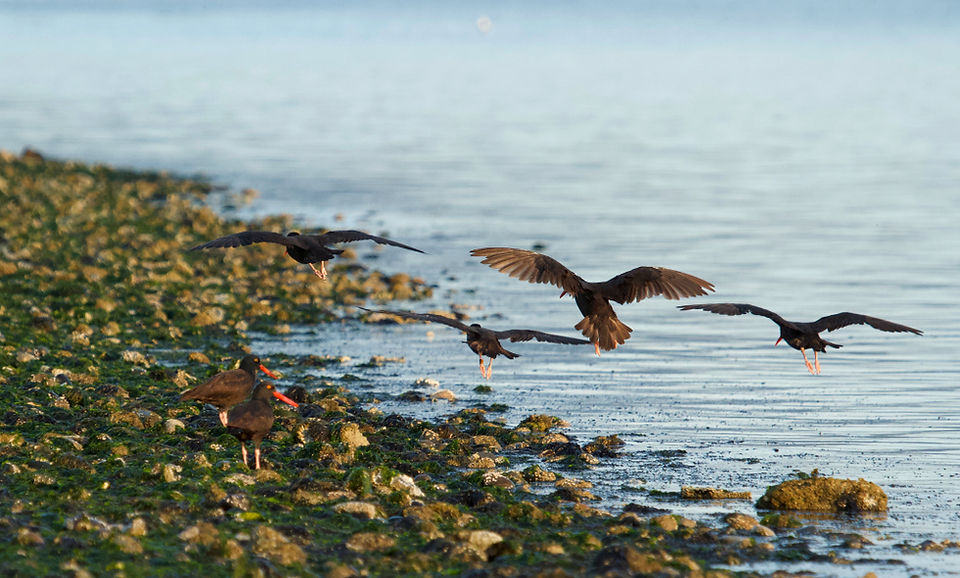
Black Oystercatchers
Birding in the SGI
The Southern Gulf Islands’ climate and location make the area an important year-round residence, a winter destination, and a migratory flyway. Mid-April to mid-May is the ideal time for birding, when winter and summer birds overlap, though there are plenty to see year-round. A field guide, a smartphone bird app like Merlin, and binoculars are necessities. A spotting scope is even better for viewing raptors, like Bald Eagles and water and shorebirds. Of the hundreds of bird species to be sighted in the SGI, not all are common to all islands.
In addition to my Five Finest Feathered Friends, birders can look forward to sightings of Belted Kingfishers, Common Ravens, Rufous Hummingbirds, Pileated Woodpeckers, California Quail, Trumpeter Swans, Pacific Loons, and a great many other shorebirds and songbirds. See the eBird: Bird Lists by SGI locations (below) for extensive inventories of species seen in various places.
Birding ethics: So that no harm comes to the birds or the environment
Three things to keep in mind when observing our feathered friends.
Keep your distance. As exciting as it is to get “this close” to a particular bird or a nest, remember that if you’re so close that the bird leaves, you’re too close. The bird will fly to safety, and may do so at the risk of leaving eggs or chicks unprotected from predators. I have unwittingly caused too many birds to take flight in the past and now adhere to a 100-metre rule. With binoculars, I can see the bird clearly from 100 metres as it goes about its normal routine. Keeping your distance also applies to your dog; please don’t let your four-legged friend take chase.
Leave no trace. Do your best not to damage the bird’s natural environment. Remove everything that you bring with you. Leaving garbage, in particular picnic food scraps, may attract predators. Please DO NOT feed wild birds.
Let nature be. A bird may appear abandoned or in distress, but probably isn’t. Young birds on the ground likely are learning to fly. Don’t worry; a parent is undoubtedly close by and will return as soon as you leave. Even a bird that appears injured or dead may not be. If it’s a hummingbird, it may be in a state of torpor—a dormant, inactive state of hibernation (in other words, this high-energy bird is simply resting). If you are certain a bird is injured, contact a local veterinarian or recognized wildlife rescue organization before touching or moving it.

A Bald Eagle scanning the surrounding skyline from its perch on a Douglas fir branch (073111).
Good locations in the SGI to see a Bald Eagle
Belle Chain Islets (near Mayne Island and Saturna Island), Brooks Point Regional Park (South Pender Island), Brown Ridge (Saturna Island), East Point Whale Trail/East Point Regional Park (Saturna Island), George Hill Park (North Pender Island), Portland Island (Inner Gulf Islands).
*eBird: Bird Lists by SGI locations highlighted in SGI Outside
The side menu in the linked eBird Bird Lists lets you view the Iconic Birds of that location and the best time to see them. eBird: Bird Lists are constantly evolving (SGI Outside regularly updates the number shown below).
See the eBird Hotspot Map for the Southern Gulf Islands.
North Pender Island
George Hill Park (GINPR): 99 species seen since 2017 (eBird)
Medicine Beach Nature Sanctuary—138 species since 2013 (eBird)
Mount Menzies (GINPR): 34 species seen since 2022 (eBird)
Roe Islet Trail, Roesland (GINPR): 101 species seen since 2015 (eBird)
South Pender Island
Beaumont Marine Park (GINPR): 80 species since 1989 (eBird)
Brooks Point Regional Park (CRD): 155 species since 1998 (eBird)
Greenburn Lake (GINPR): 110 species since 2004 (eBird)
Mount Norman Summit (GINPR): 89 species since 2007 (eBird)
Salt Spring Island
Mount Maxwell Park (BC Parks): 88 species since 1996 (eBird)
Mount Erskine Park (BC Parks): 75 species since 2015 (eBird)
Reginald Hill (SSIPARC/CRD): 57 species since 2023 (eBird)
Ruckle Park (BC Parks): 155 species since 1979 (eBird)
W̱EN,NÁ,NEĆ Tsawout First Nations Trail: 63 species since 2024 (eBird)
Mayne Island
Campbell Point (GINPR)/Bennett Bay: 140 species since 2018 (eBird)
Georgina Point Heritage Park & Lighthouse (GINPR): 98 species since 2003 (eBird)
Mount Parke (CRD): 81 species seen since 1996 (eBird)
St. John Point Regional Park (CRD): 64 species seen since 2023 (eBird)
Saturna Island
Xwiwxwyus (kwik-wi-us)/Winter Cove (GINPR): 143 species since 1973 (eBird)
Brown Ridge (GINPR/Campbell Farm): 88 species since 1973 (eBird)
East Point Whale Trail/East Point Regional Park (GINPR/CRD): 164 species since 1989 (eBird)
Narvaez Bay (GINPR): 107 species since 2013 (eBird)
Galiano Island
Bellhouse Park (BC Parks): 105 species since 2007 (eBird)
Gray Point Trail/Montague Harbour Marine Park (BC Parks): 129 species since 1970 (eBird)
Mount Galiano Nature Preserve: 68 species since 2005 (eBird)
Matthews Point Regional Park (CRD): 79 species since 2010 (eBird)
The Viewpoint Trail/The Bluffs (Galiano Club & GIPRC): 102 species seen since 1990 (eBird)
Inner Gulf Islands
Portland Island (GINPR): 134 species since 2002 (eBird)
Russell Island (GINPR): 80 species since 2009 (eBird)
Isle-de-Lis/Rum Island Trail (GINPR): 67 species since 2015 (eBird)
Mandarte Island bird research station (IBA Canada site): 107 species since 1960 (eBird)
CRD - Capital Regional District, GINPR - Gulf Islands National Park Reserve, PIPRC - Pender Islands Parks & Recreation Commission, SSIPARC - Salt Spring Island Parks, Arts, Recreation & Culture, MIPRC - Mayne Island Parks & Recreation Commission, SIPRC - Saturna Island Parks & Recreation Commission, GIPRC - Galiano Island Parks & Recreation Commission.
Counting Birds in the SGI for the National Audubon Society Bird Count
Excerpt from A 2025 Christmas Bird Count Full of Surprises
“The official Audubon count area that contains the Mayne Island count includes Saturna, North Pender, and South Pender islands. The official list submitted for our count area is a compilation of counts from each of these islands. For this year’s count the four islands tallied 91 species and 9,838 individual birds. Collectively we had 118 birders out on count day who logged just over 187 hours (this includes feeder counters) and 229 kilometres on foot, by car, or by boat to observe birds.”
Bald Eagle Resources (and great pictures, videos, audio)
Eagle Watch: 20 Years on Pender...and 60 Other Islands
For the past twenty years, Pender Island’s Dave Manning has documented Bald Eagle encounters in the Southern Gulf Islands. He calls his project Eagle Watch. In this January 30, 2026, story for the Pender Island Conservancy, Dave provides information about the species and insight into the importance of big trees for the Bald Eagle population’s health and the consequences of losing these big trees.
British Columbia Breeding Bird Atlas: Bald Eagle
Ancient Forest Alliance Creature Feature: Bald Eagles (December 2024)
Sierra Club BC: Bald Eagle
Cornell Lab of Ornithology’s All About Birds: Bald Eagle
Birds of Southwestern British Columbia (7th printing) by Richard Cannings • Paperback • $19.95 • 432 pages • Harbour Publishing, 2008. Covers more than 200 bird species in a handy, portable guide; aimed at beginning and intermediate birders.
Merlin • Merlin is a smartphone bird app created by the Cornell Lab of Ornithology; it provides birders with the ability to Identify Bird Songs and Calls, Identify Birds in a Photo, Save Birds to Your Life List, and Explore Lists of Birds Near You using your cell phone. Watch the See How Merlin Can Help You ID Birds demo video below for an introduction to this amazing bird-ID assist tool.


