

Why is the Western redcedar called the Tree of Life?

Updated: Sep 13
Ask Coast Salish First Nations peoples; they’ll tell you why. First, it’s their deep, abiding spiritual relationship with the tree. A close second? The life-sustaining benefits redcedar has provided indigenous islanders for millennia: from its wellspring of medicinal remedies to its abundance of practical wood uses.
Table of Contents
Photographs, videos, audio, and text Copyright © 2026 Richard Philpot/SGIOUTSIDE.ca.

Looking through the leaves and branches of Western redcedars along the Beaumont Marine Park Trail on South Pender Island (012022).
Whichever way you turn, walking or hiking in the Southern Gulf Islands, you’ll see Western redcedars.
With a potential lifespan of 1,000 years or more, a girth as ample as six metres (approx. 20’), and towering heights of up to 60 metres (approx. 195’), today’s forest explorers—me and you—would be appreciating these mammoth trees if not for our ancestors’ overzealous harvesting of Thuja plicata and our ongoing appetite for the wood.
Fortunately, we can still visit examples of large Western redcedars in our island neighbourhoods. I relish reaching the south end of the Roe Lake Loop Trail (Gulf Islands National Park Reserve) on North Pender Island to see examples of older redcedar trees. A two-minute side jaunt from the main trail (ESE to 48.7896, -123.29856) to the marsh next door provides several specimens stripped of bark at their base by beavers. Next to these are century-old stumps, now nurse trees. The leafless limbs of the trees at the marsh’s edge look like withered ghost appendages, and the attached wispy green moss gives the appearance of bits of gossamer.
On the main Roe Lake Trail, travelling clockwise, you’ll encounter an uncommon wind-felled Western redcedar. Most fallen trees seen to this point are firs and alders. This fallen cedar crosses the trail, lying among ferns and Salal. Until recently, the portion of the tree’s trunk on the trail had a step notched in it. For some reason, Parks Canada staff removed this novel tread board. A peek at the underside of the downed tree shows the shallowness of a Western red’s typically robust root system. The tree now hosts ferns, moss, lichens, and insects.
Scientists know the tree as Thuja plicata, but the rest of us call it Western redcedar, Pacific red cedar, giant cedar, canoe cedar, or giant arborvitae (which translates to “tree of life”). But it isn’t, in fact, a cedar at all, but a woody member of the cypress tree family. First Nations terms of endearment include mother, grandmother cedar, maker of rich women, and long-life maker.
Because of its biomass and sluggard decomposition, this native conifer captures carbon as efficiently as most anything on the planet. Every tree stores thousands of metric tons of carbon. Standing or down, it plays an essential role in the health of our island forests’ ecology.

Shiny, yellowish-green, blunt needles of the Western redcedar, opposite pairs in four rows, closely pressed to the stem and arranged like a flattened braid.
Identifying Western redcedar
Western redcedar is British Columbia’s provincial tree. It’s easily identifiable by its two Bs: Bark and Branches. The bark on the main trunk is notable for its thin, stringy, reddish-brown vertical strips. The branches extend outward from the trunk at a bit less than a right angle, then fall slightly before sweeping upward to the tip (in a J-shape when viewed in profile).
Parts of a Western redcedar:
Height: Normally up to 40 metres (approx. 130’); occasionally, large, mature trees can reach 60 metres (approx. 195’)
Trunk: Shallow, wide-spreading, secure root system; mature tree trunk spreads wide at the base, often fluted and buttressed
Bark: Reddish-brown to grey (mature trees), thin and stringy, tears off in fibrous strips (somewhat aromatic)
Branches: Limbs and flattened, horizontal, spray-like branchlets extend from the trunk, droop, then sweep upward to the tip
Leaves: Shiny, yellowish-green, blunt needles in opposite pairs in four rows; folded in one pair but not in the other; closely pressed to the stem and arranged like a flattened braid; very aromatic, turn brown when shedding at 3-4 years old
Cones: Pollen cones are reddish and small (to 4 mm/approx. .15”); seed cones are egg-shaped, one cm long (approx. .4”), with 8-12 scales in irregular clusters, green when immature, turning brown and woody, and turned upward; drop during the winter months
Other notes: Springboard cut-outs are occasionally seen on old stumps several metres from the ground (up to 9’); tree-fellers inserted chopping planks to stand on and avoid having to chop the ridged bases.
Habitat: Where to find Western redcedar
Western redcedars grow everywhere on the islands, typically in a mild climate at low to medium elevations with moist, nutrient-rich soil. They are common in shaded forests (like North Pender Island’s Roe Lake Loop Trail and South Pender Island’s Beaumont Marine Park) but are regularly seen when walking many island roads. In the Southern Gulf Islands, Western redcedars commonly grow among Douglas fir, Red alder, Bigleaf maple, Arbutus, Garry oak, and other tree varieties in forests blanketed with Salal, ferns, and mosses.

Well-aged Western redcedars next to century-old stumps (off the side trail at the east end of North Pender Island’s Roe Lake Loop Trail).
First Uses: A Tree of Life
The traditional unceded territories of the Coast Salish First Nations (the W̱SÁNEĆ people) include the Tsawout, Tseycum, Tsartlip, Pauquachin, Penelakut, and Layackson bands, among others. Evidence shows that the W̱SÁNEĆ people have lived in the Southern Gulf Islands for as long as 10,000 years.
Indigenous peoples used Western redcedar for house posts and planks, dugout canoes, boxes, mortuary and totem poles, fishing weirs, and spirit whistles. Sheets of bark were used for siding and roofing, and the inner bark was used for clothing, rope, and baskets. They used flexible branches for fish traps and roots for cord. All parts of the tree were utilized. Western redcedar was easily split because of its straight grain. Mature trees produce thujaplicin, a natural chemical that delays decay in wet climates. Its rot and insect resistance means even windfalls remain sound and salvageable for years.
Western redcedar had many medicinal uses, addressing various ailments due to its antibacterial and antifungal properties.
Ringworm, athlete’s foot, and similar afflictions were treated with a redcedar solution, applied multiple times per day for up to a week
Redcedar oil was used externally on fungal infections and warts (the oil in the leaves is toxic, affecting blood pressure, producing convulsions, and even causing death)
A cold bark and twig infusion was given twice daily to those with kidney troubles and bladder and urethral irritability (it was never used for extended periods)
A fruit and leaves decoction alleviated coughs
Redcedar buds were chewed to resolve a toothache
Pregnant women inhaled steam from infusions to promote easier delivery (it was never taken internally).
A Coast Salish myth says the Great Spirit created redcedar in honour of a man who was always helping others: “When he dies and where he is buried, a cedar tree will grow and be useful to the people—the roots for baskets, the bark for clothing, the wood for shelter.” (Stewart 1984:27).
Today
Old-growth Western redcedar (250 years or older) is a valuable commodity in today’s Western society. The wood is turned into everything from fencing and roof shakes to playground structures and patio furniture. The long-fibre pulp can even be used to make disposable hospital gowns and masks. Redcedar logs fetch as much as five times the rate of other conifers; the vast majority is shipped out of British Columbia.
The mystical draw of redcedars
I’ve heard that people can acquire strength by standing with their back to a Western redcedar tree. What type of strength? Physical toughness? Courage? Energy? Better health? I think it’s the last two.
Living trees are alive. Redcedars, in particular, feel alive. While I don’t feel a spiritual air in their presence, it does alter my emotional state. I’m touched by a sense of natural joy, leaving me with heightened happiness. My eyes are drawn up, following a single tree’s trunk skyward until my view is a mixture of green, blue, and sunshine. My heart rate eases.
The metre-and-a-half-wide, soaring redcedar above me and the shaggy, slowly decaying cedar on the forest floor are my “trees of life,” too. They relax me and make me smile.
Final words
Noticing, identifying, and learning about plants in their natural setting and appreciating their significant roles in life, past and present, adds an extra dimension to my time spent outside in the Southern Gulf Islands.
Enjoy our islands with a wondering nature. Don’t forget to look up . . . and around and down. See you outside.
Recommended Field Guides
Plants of Coastal British Columbia including Washington, Oregon & Alaska by Jim Pojar & Andy MacKinnon • Paperback • $24.95 • 530 pages • 5.5” x 8.5” • B.C. Ministry of Forests, Partners Publishing and Lone Pine Publishing, 1994/2014 • Easy-to-use field guide features 794 species of plants commonly found along the Pacific coast from Oregon to Alaska, including trees, shrubs, wildflowers, aquatic plants, grasses, ferns, mosses and lichens.
Edible and Medicinal Flora of the West Coast, British Columbia and the Pacific Northwest (Expanded Edition) by Collin Varner • Paperback • $26.95 • 272 pages • 5.5” x 8.5” • Heritage House Publishing, 2023 • Practical, user-friendly guide for beginners and experienced SGI foragers.
Plants of the Gulf & San Juan Islands and Southern Vancouver Island by Collin Varner (Raincoast Pocket Guides, 2002) OUT OF PRINT
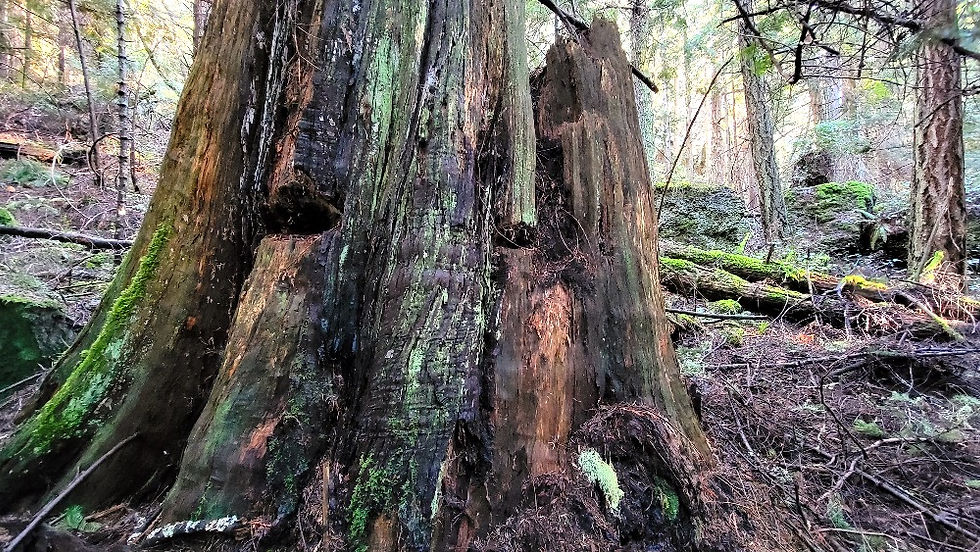
Springboard logging mark: Tree-fellers inserted planks to stand on to avoid having to chop the fluted bases (012022).


