

Marine mammals we all love

Updated: Sep 11
Killer whales (orcas), harbour seals, and sea lions inhabit Southern Gulf Island waters. The likelihood of sightings increases with keen senses, binoculars, and knowing the best places to score an encounter. An exceedingly shy porpoise, which is rarely observed, is also on ocean lovers’ bucket lists, along with sporadically spotted humpbacks, minke whales, and Northern elephant seals.
Table of Contents
Photographs, videos, audio, and text Copyright © 2026 Richard Philpot/SGIOUTSIDE.ca.

Female Southern Resident killer whale (orca) breaching in Swanson Channel off North Pender Island (CE0225).
Killer Whales (Orcas): Two types; the ocean’s apex predator
Most scientists call them killer whales; the rest of us generally refer to them as orcas. The Nootka First Nation on the west side of Vancouver Island uses the name Qaqawun, and North Vancouver Island’s Kwakiutl Nation uses the name Max’inux. Other common names include blackfish, grampus, and killer.
Whichever you choose to call the species, you may be surprised to learn they’re not even whales but one of thirty-five (35) species and the physically largest member of the oceanic dolphin family, Delphinidae. They’ve long been considered whales because of their size. Two orca ecotypes visit the Southern Gulf Islands: Southern Resident, almost exclusively fish-eaters, and Bigg’s (formerly known as Transient), which eat warm-blooded creatures like seals, sea lion pups, porpoises, and seabirds.
At last count (by San Juan Island, WA-based Center for Whale Research), 74 Southern Resident killer whales (SRKW) make the Salish Sea their primary residence (which includes Canada’s Southern Gulf Islands and the United States’ San Juan Islands and Puget Sound). This fish-eating community is made up of three families, or pods—J, K, and L—with J pod being the most frequently seen in the SGI area. The Center for Whale Research “names” the orcas with an alphanumeric designation based on their pod and birth order (e.g., J62 was born and numbered before J44).
SRKW are individually identified by their unique saddle patch markings and dorsal fin and are referred to by their alphanumeric designation. Their saddle patch—the whitish-grey pigmentation on their back—varies from orca to orca (shape, colour, and scratches). Their dorsal fins vary in size and shape, showing distinct nicks and scars that change over the animal’s lifetime. Most maturing males (15+ years) are easily identified by tall, straightish dorsal fins achieving a height of two metres (approx. 6 feet).
The Bigg’s orca population is estimated at 350, with certain families seen more frequently in the SGI region. Their dorsal fins are shark-like-pointy, and their saddle patches are more prominent and evenly grey. Bigg’s travel in smaller groups (2-12) than Southern Residents when silently stalking their next meal—harbour seals or sea lions hauled out on rock outcroppings or sea birds lounging on the water’s surface. In 2002, Salt Springers watched in horror as five Bigg’s corralled and killed a small minke whale in Ganges Harbour.
Distinguishing young orca males and females is difficult, as both share panda-like markings and the same curved-back shape to their dorsal fins. When youngsters breach or roll over, exposing their bellies, the male reveals an elongated white pattern around its genital slit; the female’s pattern is somewhat rounded with mammary slits. One in six calves dies before their first birthday. Mothers transfer toxins to their calves during gestation and nursing, often resulting in failed pregnancies.
Southern Resident orca pods are matriarchal. Even the largest and oldest males travel with their mothers, leaving for short periods to breed with reproductive females in the community’s other pods. When the matriarch dies, family members stay together, maintaining the family unit. Grandmothers play a crucial role in teaching youngsters where and how to forage for meals. It’s rare to see all SRKWs travelling together due to dwindling Chinook salmon stocks, their primary prey, which forces them to spread out in search of food (and travel greater distances).
When underwater, Southern Resident orcas use echolocation clicks to navigate and find food, and repetitive pulsed call types and tonal whistles to communicate. The three pods use their own dialects but can likely understand each other. Researchers have identified at least 25 call types. Biggs are a relatively silent species and don’t mix with the Residents.
Biological profile: Killer Whale/Orca (Orcinus)
Status: SRKW—Endangered (Canada and United States); Bigg’s—Threatened in Canada (2003).
Name: From the Latin phrase Orcinus orca; Other names—killer whale, blackfish, grampus, killer, Qaqawun, and Max’inux.
Life Expectancy (SRKW): Females—estimated 35 years, but can live much longer (J2 was thought to be 80 or older when she died in 2016); Males—19 years, although J1 was estimated to be 59 years old. Most orcas disappear below the ocean surface when they die.
Diet: SRKW—fish eaters (80% Chinook salmon), consuming an estimated 18-25 adult salmon daily (at least 1,300 salmon to sustain the community); pods’ movements are determined by food availability. Bigg’s—mostly eat seals, sea lions, and porpoises.
Avg. Size & Weight: Females—6-7 metres (18-22 feet) and 3,500-5,000 kg (8,000–11,000 lb.); Males—6-8 metres (20-26 feet) and 5,400 kg or more (12,000 lb.); Calves—2-3 metres (7-8 feet) about 180 kg at birth (400 lb.).
Physical Features:
Colouration: Black with a whitish-grey saddle patch and white belly.
Head: Conical-shaped with a small rostrum and 10-13 teeth on each side of both jaws. Rip food into chunks or eat it whole rather than chew it. Eyes on the side of the head, below and in front of the white eye patch (orcas have excellent eyesight underwater and above). Small ears behind their eyes, with no external flap.
Fins & Saddle Patch: Large, paddle-shaped flippers or pectoral fins used for steering and stopping (along with its flukes) and a distinct dorsal fin on its center-back (curved in females and immature males; straight, and up to 2 metres in mature males, the largest of all marine mammals). The male’s dorsal fin reaches its full height between 15 and 25 years.
Flukes: Each half of the tail is a fluke, curled at the ends; muscles, where the tail meets the body (caudal peduncle), move the flukes up and down; flukes can measure up to 2.75 metres across (9 feet).
Brain: Can weigh up to 7 kg (15 lb.).
Blubber: 7-10 cm (3-4 in.) of insulating blubber beneath the skin; stored fat provides energy when food is in short supply.
Breathing: Conscious breathers; underwater pulse—approx. 30 BPM; above the water—60 BPM.
Reproduction: Mating and calving take place year-round. Females are sexually mature in their early teens. Gestation lasts 18 months. One in six calves dies before their first birthday. The average SRKW birth rate is one healthy calf every 9-10 years.
Social Structure: Matriline (the most important social unit)—comprised of a female, her sons and daughters, and the offspring of her daughters; strong bonds; individuals depart from the group for only hours. Pod—related matrilines form a pod. Clan—pods sharing similar vocal dialects and a common but older maternal heritage. Community—regularly associating pods and clans are known as communities. Community members of the same sex and a similar age like to socialize. Females, calves, and juveniles are inclined to be most socially active. Social proclivity declines with age.
Behaviours: Instantaneous and Prolonged physical behaviours and maneuvers. Full Breach—reaching an exit speed of 40 km/hr before leaping, twisting in the air (clearing the ocean surface), and landing on their side or back. Spyhopping—rising vertically above the water surface to look around, showing their white bellies up to their pectoral fins. Pectoral or Tail Slaps—roll onto one side and repeatedly splash the water surface with their pectoral fin or slap the surface with their flukes. Sleep—probably “sleep” by shutting down one hemisphere of their brain; simultaneously, the other half maintains breathing and awareness of surroundings.
Top Speed: When porpoising, orcas can briefly attain speeds of 28 knots (50 km/h, 32/mph).
Range: SRKW (influenced by seasonal Chinook salmon migrations )—Spring/Summer/Fall in the Salish Sea and offshore of Vancouver Island and Washington; Winter as far north as British Columbia’s Haida Gwaii (Queen Charlotte Islands) and south to California’s San Francisco Bay Area. J-pod is observed in the region’s waters year-round. Bigg’s (Transient) travels as far as Southeast Alaska and California, but now spends more time in the inland waters of British Columbia and Washington State due to prey abundance.
Primary Threats: SRKW—Lack of food (quantity and quality of Chinook salmon), environmental contaminants, noise and vessel disturbance. Bigg’s—Toxins, spills, noise, and vessel disturbance.
Learn more at the Center for Whale Research’s WhaleResearch.com.
Best places to see Southern Residents and Bigg’s in the SGI:
Shoreline viewing:
Galiano Island—Active Pass from Bluffs Park and Bellhouse Provincial Park (SRKW and Bigg’s)
Mayne Island—Active Pass from Georgina Point/GINPR (SRKW and Bigg’s)
North Pender Island—Thieves Bay Marine breakwater; Oaks Bluff Park (SRKW and Bigg’s)
South Pender Island—Gowlland Point and Brooks Point Regional Park (SRKW and Bigg’s)
Salt Spring Island—Ruckle Park Campground shoreline (Bigg’s)
Saturna Island—East Point/GINPR (SRKW and Bigg’s)
While paddling (Please stay 400 metres away; Watching marine wildlife):
Boundary Pass—East Point and Monarch Head, Saturna Island; Gowlland Point and Brooks Point Regional Park, South Pender Island (SRKW and Bigg’s)
Moresby Passage—South side of Portland Island (Bigg’s)
Plumper Sound—Between Saturna Island and South Pender Island (SRKW and Bigg’s)
Swanson Channel—Between North Pender Island and Moresby Island (SRKW and Bigg’s)
Between North Pender Island/Maynd Island and Prevost Island (SRKW and Bigg’s)
GINPR—Gulf Islands National Park Reserve
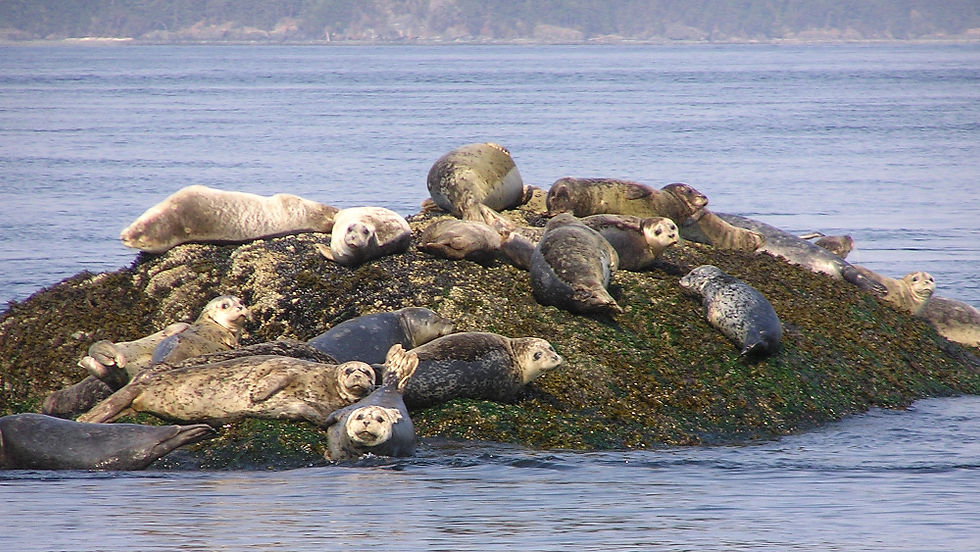
Twenty Pacific harbour seals laze in the sun on a rock outcrop near Salt Spring Island (092306).
Pacific Harbour Seals: Rock stars
Pacific harbour seals are the only resident seals of British Columbia. An estimated 100,000 reside along the coast. They are the most commonly seen marine mammal in the Southern Gulf Islands.
Harbour seals spend as much time out of the water as in, favouring haulouts on rock outcrops, sheltered rocky shores, reefs, and sand and gravel beaches and low tides where they and their friends can safely rest and sun themselves and are close to food sources. These relaxed-looking pinniped groups are generally their largest in summer. If you approach too closely, they’ll scurry into the water and surface with barely a sound, their large, inquisitive eyes checking to ensure all is safe. Disturbances during pupping season can cause separation or abandonment, resulting in the deaths of some pups. Haulout locations that experience regular human disturbance may be abandoned entirely. Please stay 100-200 metres away (Watching marine wildlife).
Harbour seals can dive to 90 metres (300 feet) and up to six minutes when fishing. They slow their heartbeat by 90% and reduce their body temperature and blood flow to all but essential organs (heart and brain). With pupils dilated, they can see clearly even in the darkest water.
Biological Profile: Pacific harbour seal (Phoca vitulina richardsi)
Status: Not at Risk in Canada (April 1999). The Pacific harbour seal density in the Salish Sea is almost three per square ocean kilometre, making it one of the densest populations on the planet.
Size & Weight: Adult females (cows) 1.2-1.7 metres (4-5.5 feet) and 45-105 kg (100–230 lb.); adult males (bulls) 1.4-1.9 metres (4.5-6.5 feet) and 55-140 kg (120–300 lb.). Newborn pups are 70-100 cm (2-3 feet) and 8-12 kg (17–26 lb.).
Physical Features: Pale white to nearly black coats with light or dark spots, rings, and splotches (permits identification). Large eyes, protected by oily “tears,” help them see in deep and dark water. Hearing is 14 times greater underwater (160 kHz) than above the surface (12 kHz); they may use echolocation. Whiskers “feel” unfamiliar objects and detect prey by sensing pressure changes in the water. They usually swim underwater for 5-8 minutes but can stay submerged for close to 1/2 an hour. Sleep underwater, surfacing subconsciously to breathe. Normal swimming speed is approximately 4 knots (7-8 km/h); they can reach 12.5 knots (23 km/h) when pursuing prey.
Life Expectancy (Average): Females—10 years (up to 30 years), males—8 years (up to 20 years). Breeding-season stressors shorten males’ lifespans.
Natural History: Haul out to rest, avoid predators, reproduce, and moult. Mating—Males attract females by growling, rolling, and slapping their posterior flippers on the water surface; males mate with several females in mid-to-late summer. Mating occurs after weaning. Pupping season—June-Oct (peaks July-Aug), shortly after the previous year’s pup has been weaned. A single pup is born on a tidal reef or beach, nursed and protected by its mother for about 30 days (nursing usually occurs at low tide). Mothers may leave their pups alone onshore for short periods while they forage for food. Mom uses smell to locate a stray pup. Pups can swim and dive soon after birth, but are not at full strength until well after weaning; they are sometimes seen riding on their mother’s back in their first weeks.
Diet: At least 60 fish species (herring, salmonids, perch); in deep water, Pacific hake. Consume 2-3 kg (4.5-6.5 lb.) per day. Also eat crustaceans and mollusks, including octopus.
Threats (Salish Sea): Predators—Bigg’s killer whales (knock seals into the ocean from their haulout), eagles, turkey vultures, coyotes, domestic dogs, and others. Boat Strikes—fatal propeller strikes. Toxins—compromise seals’ immune system health. Disease.
The best places to see Pacific harbour seals in the SGI:
Shoreline viewing (almost anywhere there’s a rocky outcrop and/or a Bull kelp forest):
Isle de Lis/GINPR—Tom Point
Mayne Island—Georgina Point/GINPR
South Pender Island—Brooks Point Regional Park
Saturna Island—Winter Cove, East Point/GINPR, and Thomson Community Park
While paddling:
Anniversary Island and Belle Chain Islets/GINPR—Northeast of Samuel Island
Georgeson Passage haul-outs
Portland Island/GINPR—East side haul-out and around Pellows Islets
North Pender Island—Seal Rock, Peter Cove, and Port Browning haul-outs
South Pender Island—Various shoreline spots and Blunden Islet
Java Islets—South side of Saturna Island
GINPR—Gulf Islands National Park Reserve
A Natural Debate
What should you do if you discover an orphaned seal pup along the shoreline?
Like most issues, this one has opposing viewpoints.
Conservationists argue that abandoned, orphaned, or injured wildlife shouldn’t be rescued; nature should run its course. Rehabbers disagree. disagree. They claim that unnatural, human-made factors often cause wildlife abandonment and injury, so we are responsible for caring for these injured creatures.
If you come upon a seal pup or injured wild animal while on one of the Southern Gulf Islands and are uncertain what to do, please call the Island Wildlife Natural Care Centre on Salt Spring Island (250.537.0777).

Steller sea lions roaring from their Belle Chain islet haulout (111705).
California and Steller sea lions: Part-timers making noise about nothin’
Two marine mammals—California and Steller sea lions—return annually to haulouts in the Belle Chain Islets (off Samuel Island), Helen Point (Mayne Island), and other spots. But it’s a Boys’ Club only.
Both species arrive in the fall: the Californians from islands along the West Coast as far south as Mexico and the Stellers from one of three rookeries along the British Columbia coast. Their female partners and offspring stay behind. The males remain in our area through the non-breeding winter months before dispersing and heading home in the spring.
California sea lions are the smaller of the two, measuring 2 metres and weighing 300-450 kg. Their hairy skin is very dark brown, and their bark differs from the Steller’s deep growl. Californians are also more social and known for their playfulness. Occasionally, you’ll see one or more porpoising or leaping from the water as they swim. Approach a haulout of Stellers too closely, and one or more will “haul-ass” into the water and chase you until they’re comfortable with your location.
It’s easy to confuse swimming sea lions with Pacific harbour seals. How can you tell the difference? Sea lions have a much more pronounced curve in their facial profile from the forehead to the nose. They’re quite a bit bigger and swim more quickly, leaving more of a wake on the ocean surface.
They choose to spend so much of their time on rocky areas offshore to be inaccessible to their predators—Bigg’s (Transient) orcas. Until 1970, humans also hunted them; now they’re legally protected from commercial hunting, and their numbers have grown significantly. Some BC fishermen claim sea lions are depleting the salmon stocks, but biological studies don’t support these claims.
Biological profiles: California & Steller sea lions (MALES)
Status: CALIFORNIA—IUCN Least Concern (2021). STELLER—SARA Special Concern (COSEWIC 2013) based on sensitivity to human disturbance and vulnerability to catastrophic events (e.g., major oil spill).
Common Name: CALIFORNIA—California sea lion. STELLER—Steller sea lion, Steller’s sea lion, northern sea lion, seawolves.
Size & Weight: CALIFORNIA—Up to 2.5 metres (8 feet) and 300 kg (660 lb.). STELLER—Up to 3 metres (10 feet) and 1,000 kg (2,200 lb.); the largest of the eared seals.
Physical Features: BOTH—Well-developed facial whiskers used to “feel” their way underwater and sense prey. Four web-like flippers; back pair can pivot forward on land to walk and climb. CALIFORNIA—Dark brown to black coat, light brown sagittal crest* (fully developed in adults), broad forehead, long, straight snout. Raspy, dog-like bark. STELLER—Tan coat with darker undersides and around flippers; mane of coarse guard hair and a sagittal crest* less prominent than California; robust head with a short, blunt snout; deep roar. *Lengthwise, midline “bump” on top of their skull.
Life Expectancy (females live longer): CALIFORNIA—15-25 years. STELLER—Average 4 years (up to 16 years).
Playful Activities: BOTH—Curious and gregarious; highly intelligent. CALIFORNIA—Average diving depth is 25-100 metres (80-325 feet); record depth is 536 metres (1,168 feet); most dives last two minutes (but up to 20 minutes). STELLER—Deepest recorded dive is 424 metres (1,400 ft). Can remain submerged for 15-20 minutes. Approach a haulout too closely, and one or more will take to the water and confront you.
Diet: BOTH—Extensive variety includes herring, salmon, cod, rockfish, sculpins, squid, octopus, and even an occasional seal pup. Approach commercial and sport-fishing boats, seizing fish from nets and lines.
Threats (Salish Sea): Humans—Commercial fishing-gear entanglements and boat strikes; killed in conflicts with fishers. Pollution—human-made and disposed-of toxins—compromises seals’ immune system health. Disease and Parasites—Natural and human-caused. Natural Predators—Bigg’s killer whales.
More information: California sea lion. Steller sea lion.
The best places to see California and Steller sea lions in the SGI:
While paddling: You’re virtually guaranteed to encounter sea lions when winter paddling around the Belle Chain Islets (GINPR), northeast of Samuel Island (I launch my kayak from North Pender or Bennett Bay on Mayne Island).
Shoreline viewing: Once or twice each winter, I see a sea lion or two swimming by the Thieves Bay Marine breakwater (North Pender Island). theWhaleTrail.org lists several places in the SGI where you might view sea lions: Bellhouse Provincial Park (Galiano Island), Active Pass from Georgina Point/GINPR (Mayne Island), and East Point/GINPR (Saturna Island).
Aboard BC Ferries: At the west end of Active Pass, Helen Point on Mayne Island is a popular haulout for male sea lions. You’ll see and hear them from the outside ferry deck.

Three Harbour porpoises surface for a quick breath of fresh air.
Harbour and Dall’s porpoises: Life with Porpoise
Both cetaceans are relatively small, with tiny flippers, a pudgy shape, and no prominent beak. Identifying which species is which as they swim by is not always easy. The super-shy Harbour porpoise only exposes its triangle-shaped dorsal fin for an instant before curling back into the water. Keep your eyes peeled. Unlike its antisocial cousin, Dall’s porpoise tends to be sparkier, often producing a “rooster tail” of spray when breaking the water surface to breathe.
The name porpoise is derived from two Latin words: porcus, meaning pig, and piscus, meaning fish. Of the six known species of “pig fish” inhabiting the planet’s oceans, two—Harbour and Dall’s— reside in B.C.’s Southern Gulf Islands. You’ll best tell them apart from their surface-breathing pattern and the Dall’s black and white-coloured, sickle-shaped dorsal fin.
At least one member of each species has spent intimate time together in British Columbia. A fetus removed from a dead Dall’s porpoise was proven, through DNA sequencing, to have been fathered by a Harbour porpoise.
What predators pose the most danger to the Pacific’s porpoises? Biggs orcas and us—humans. Many porpoises are killed each year in trawls, gillnets, and other fishing gear. Japanese fishers decimated the Dall’s porpoise during the past century, killing more than 500,000 porpoises since catch records were first kept in the early 1960s. Some good news: “The huge hunts of tens of thousands of Dall’s porpoises and other species out of Iwate Prefecture in the north of Japan have been virtually wiped out due to the Fukushima earthquake and tsunami in March 2011, which badly damaged fishing boats and ports in Iwate Prefecture.” (International Mammal Project, a project of the Earth Island Institute)
Biological profiles
Harbour porpoise (Phocoena phocoena)
Status: SARA Special Concern (COSEWIC 2016).
Common Name: Harbour porpoise, common porpoise, sea pig, and herring hog.
Size & Weight: 1.4-1.7 metres (4.5-6 feet) and 40-60 kg (90-130 lb.); females slightly larger than males. Calves 70 cm (28 in) and 6 kg (13 lb.).
Physical Features: Dark grayish-brown cape, lighter gray flecks or stripes on its white sides and belly. Dark stripe from the corner of the mouth to the pectoral flipper. Medium-sized, triangular dorsal fin at mid-body. Small, stocky body with a rounded head and no beak.
Natural History: Mating peaks in late summer to early fall. Females may become pregnant for several years in a row. Gestation lasts 10 to 11 months; births take place May-July. Calves nurse for approximately 9 months but start on solid food at 5 months.
Life Expectancy: 8-12 years (up to 20 years)
Behaviour: Solitary and antisocial. Usually seen alone or in small groups of 2-8. Boat-shy. As the porpoise quietly rolls at the water surface to breathe, its dorsal fin is briefly visible, 6-8 breaths per minute (stays submerged 2-6 min); they rarely show their flukes or fully breach the surface.
Communication & Navigation: Emit a broad frequency range of sounds (40 Hz to at least 150 kHz); some that humans can hear and others above the range of human hearing. Use echolocation click bursts to hone in on prey and slowly repeated clicks for navigation. Researchers have reported possible social or communication whistles.
Diet: Feed on herring, hake, cod, and small squid; catch prey with spade-shaped teeth and swallow it whole (some die trying to swallow too large prey). Often generates a splash when feeding along a tide line. Maximum diving depth: 220 metres (650 feet).
Threats (Salish Sea): Natural Predators—Bigg’s killer whales. Humans—Noise, entanglements (especially gillnets), and other fishing activities. Pollution.
Dall’s porpoise (Phocoenoides dalli)
Status: IUCN Least Concern (2017).
Size & Weight: Largest porpoise species, up to 2.2 metres (7 feet) and 200 kg (440 lb.). Females are slightly smaller than males. Calves up to 1 metre (39 in) and 11 kg (24 lb).
Physical Features: Often mistaken for a baby Orca. Mostly black, with a stocky body and white patches on the belly and flanks. Tiny head, short beak. Small flippers are positioned well forward. Wide triangular dorsal fin positioned mid-body.
Natural History: Males compete for exclusive access to reproductive females (who give birth annually). Females most often mate in summer, about one month after giving birth in June-August. Gestation lasts 10 to 12 months; lactation lasts at least two months. Sexual maturity—Females (4-7 years), males (3.5-8 years).
Life Span: 8-10 years (extreme case 22 years).
Behaviour: Usually in groups of 2-10. Dive times—2-4 minutes. Rooster Tail—Often creates fan-shaped “rooster tails” splashes when surfacing. Bow Riding—Males weave through a boat’s bow waves, preferably boats travelling at 11 knots (20 km/h) or faster. Top speed—Up to 30 knots (55 km/h); one of the fastest small cetaceans in the world’s oceans.
Diet: Varied diet of small schooling fish (vertically migrating) and cephalopods like squid and octopus.
Threats (Salish Sea): Natural Predators—Bigg’s killer whales. Environmental contaminants.
More information: Harbour porpoise. Dall’s porpoise.
The best places to see Harbour and Dall’s porpoises in the SGI:
While paddling: Harbour porpoises surface everywhere but only for an instant. When you see one, key in on that area for several minutes and you’ll almost certainly see it again (and its travelling companions). I’ve never seen a Dall’s porpoise that I know of.
Shoreline viewing: theWhaleTrail.org lists these SGI places where you might see Harbour and/or Dall’s porpoises: Bellhouse Provincial Park (Galiano Island), Active Pass from Georgina Point/GINPR (Mayne Island), and East Point/GINPR (Saturna Island)
Final words
Always look around—ahead, sideways, up and down, and behind. It’s the only way to see all that our islands offer. Please enjoy yourself with a wondering nature and be respectful. See you outside.
Bye for now.
Recommended Field Guide
Whelks to Whales: Coastal Marine Life of the Pacific Northwest, Newly Revised and expanded Third edition by Rick M. Harbo • Paperback • $28.95 • 352 pages • Harbour Publishing, 2022.

Southern Resident orca waving “so long” with its massive pectoral fin (CE0231).

